
- Confidence & Child Development
- Parent Guides
Helping Your Child Feel Ready: A Pre-Start Guide for Anxious Beginners
How do you prepare an anxious child for a new activity? From what to say to what to pack, this guide gives parents everything they need before the 1st session.
If your child is nervous about starting something new, you are not alone, and neither are they. That mix of excitement and apprehension before a new club or class is one of the most common things parents tell us about, and it is also one of the most manageable with a little thoughtful preparation. According to child psychology experts at the Child Mind Institute, one of the most effective things a parent can do is arm their child with as much knowledge as possible about what to expect, practise simple social scripts at home, and keep their own tone calm and confident [1].
This guide is for families whose child is about to begin a new activity, whether that is a performing arts class, a sports club, or any group setting where they will be meeting new people and trying something unfamiliar. It is not about eliminating nerves. It is about helping your child feel ready enough to walk through the door and discover what is on the other side.
At a glance
Key takeaways
- 01Nerves before a new activity are normal and healthy; they do not mean your child is not ready.
- 02A calm, honest conversation at home is the single most effective preparation tool available to you.
- 03Helping your child visualise a positive first session reduces the fear of the unknown before they arrive.
- 04Arriving a few minutes early and packing a small comfort item can make the first day feel much more manageable.
- 05Consistency matters more than confidence: regular attendance builds familiarity faster than any pep talk.
- 06Teachers at well-run clubs and classes are experienced at welcoming nervous beginners and helping them settle in.
- 07A short, cheerful goodbye is usually more helpful than a prolonged farewell at the door.
Why Starting Something New Feels So Big for Children
Before we talk about what to do, it helps to understand what is actually happening for your child. Starting a new activity is not just a logistical change. For a young child, it involves navigating an unfamiliar space, reading social cues from people they have never met, and performing or participating in front of others, all at the same time. That is genuinely a lot to process.
The difference between “nervous” and “not ready”
Nerves are not a warning sign. They are often a signal that your child cares about doing well, that they are aware of the world around them, and that they are paying attention. Clinical psychologist Dr Rachel Busman of the Child Mind Institute notes that parents can sometimes feel pressure for their child to respond like everyone else, when in reality sensitivity and caution are simply part of some children’s personalities, not deficiencies [1]. A child who is worried about a new club is not a child who cannot cope. They are a child who needs a little more information and a little more reassurance before they feel safe enough to try. Those are two very different things, and recognising the distinction makes all the difference to how you respond.
The goal is not to get your child to stop feeling nervous. The goal is to help them feel capable of managing those nerves, and to trust that what waits for them on the other side is worth it.
Why the unknown is the hardest part
For most children, anxiety in a new group setting is almost never about the activity itself. It is about the gap between what they know and what they cannot yet picture. What will the room look like? Who will speak to them first? What happens if they get something wrong? These questions fill the space that experience has not yet occupied. The good news is that the unknown is the one thing you can actually do something about before the first session even begins. The practical sections below are all built around that single insight: reduce the unknowns, and you reduce the anxiety.
Conversations to Have Before the First Session
This is where preparation begins, and it begins at home, in an ordinary conversation, probably at the kitchen table or on the way somewhere in the car. You do not need a script. You need a calm voice and a willingness to take your child’s feelings seriously without amplifying them.
How to talk about nerves without making them bigger?
The language you use matters more than you might think. Well-meaning phrases like “you’ll be fine, don’t worry” can unintentionally dismiss what your child is feeling, which tends to make the feeling louder rather than quieter. Instead, try validating the emotion and then redirecting: “It makes complete sense to feel a bit wobbly about something new. Everyone there will be learning too.” According to the Child Mind Institute, expressing positive but realistic expectations works far better than false reassurance. Rather than promising your child they will love it, express confidence in their ability to handle whatever happens [2]. That is a subtle but important shift. It tells your child: you are capable, not: there is nothing to worry about.
Avoid leading questions too. “Are you nervous about tomorrow?” plants the seed of anxiety even when your child had not been thinking about it. Open-ended questions work better: “What are you curious about?” or “Is there anything you want to know before we go?”
Telling them what to expect, step by step
One of the most powerful things you can do is walk your child through the sequence of events before they experience it. Not in a way that raises every possible scenario, but in a way that turns the unknown into the known. Try narrating the journey: “We’ll park near the front, walk in together, and a teacher will be there to say hello. You’ll probably sit with the other children first, and then the session will begin. When it’s finished, I’ll be right there waiting.” Experts at the Child Mind Institute consistently highlight previewing and role-playing as among the most effective tools for socially anxious children, because they make the activity feel less new and less overwhelming when the real moment arrives [1]. You are not removing the experience. You are giving your child a mental map so they are not navigating completely blind.
A simple role-play exercise to try at home
Role-play sounds more formal than it needs to be. In practice, it is just a few minutes of low-stakes practice the evening before. Try acting out a greeting: “Pretend I’m the teacher. What would you say when you walk in?” Keep it light and playful rather than pressured. You are not rehearsing for a performance; you are helping your child hear themselves say the words out loud so they feel less foreign on the day. You can also ask your child to name one thing they are curious about or one thing they are looking forward to, however small. Anchoring attention to a single positive detail, rather than the whole session, reduces the sense of overwhelm considerably.
Visualisation and Mindset: Helping Your Child Picture Success
Visualisation does not need to involve anything elaborate. It is simply the practice of helping your child build a positive mental picture of an experience before it happens, so the brain has something to reach for rather than a blank space filled with worry.
“Imagine walking in and everyone smiling”
Try this in the car on the way, or at bedtime the night before. Ask your child to close their eyes and picture walking into the room. Describe it gently: “Imagine the teacher smiling and saying hello. Imagine finding a spot and looking around and seeing other children who are also just starting out.” You are not telling them it will definitely be like this. You are giving them a positive possibility to hold onto. For children who find the world a little too exposing, why performing arts works so well for children who don’t like attention is partly because the environment itself is designed around creative play rather than individual scrutiny, which makes the visualisation of a warm, low-pressure room a realistic one rather than wishful thinking.
Talking about one small thing they are looking forward to
Rather than asking your child to feel excited about the whole session, ask them to find one small thing they are curious about or looking forward to. It might be a particular kind of music, the idea of learning a dance move, or simply the fact that there will be other children their age. This anchoring technique works because it gives the brain a concrete positive to focus on, rather than leaving it to fill the space with imagined difficulties. Over time, these small anchors become the memories that replace the nerves.
What to Pack and How to Prepare on the Day?
Practical preparation is underrated. The more logistics you can resolve in advance, the fewer things there are to go wrong on the day, and fewer things going wrong means a calmer child and a calmer parent.
The practical checklist
Before you leave the house, run through the following:
- A snack beforehand, so your child is not hungry or low on energy when they arrive
- Water, if the session runs for more than an hour
- Comfortable clothing appropriate for the activity
- Any kit or equipment the provider has asked you to bring
- A small comfort item tucked quietly into their bag: a favourite keyring, a folded note from you, or a small soft toy for younger children. It does not need to come out; knowing it is there is often enough
- Confirmation of where you will be waiting when the session ends. Tell your child this explicitly, not just once but twice
Arriving early: why five extra minutes can change everything
Arriving a few minutes before the session fills up gives your child the chance to take in the space while it is still calm. They can see the room, notice where things are, and feel the environment settle around them rather than walking into a room already buzzing with energy and noise. Child psychologist advice consistently supports arriving early as a practical tactic for anxious children: it allows them to acclimate at their own pace before the social demands of the session begin [1]. Five minutes is often all it takes to shift a child from overwhelmed to curious.
The goodbye that helps, and the one that does not
A short, warm, confident goodbye is almost always more helpful than a prolonged one. When a parent lingers, crouches down repeatedly, or repeatedly checks in, it can unintentionally signal to the child that there is something to be worried about. The farewell itself becomes the cue for anxiety. Keep it cheerful, specific, and brief: “Have a brilliant time. I’ll be right outside when you finish.” Then go. If your child is upset at the door, stay calm, hand them over to the teacher with a warm word, and trust the process. A little resistance at the door is extremely common and rarely reflects how a child feels once they are inside and engaged.
What Happens Inside: What Good Teachers Do
One of the most reassuring things to know, as a parent, is that the teachers and coaches running well-run activities have seen nervous beginners many, many times. Your child is not an unusual case. They are a familiar one, and experienced teachers know exactly how to respond.
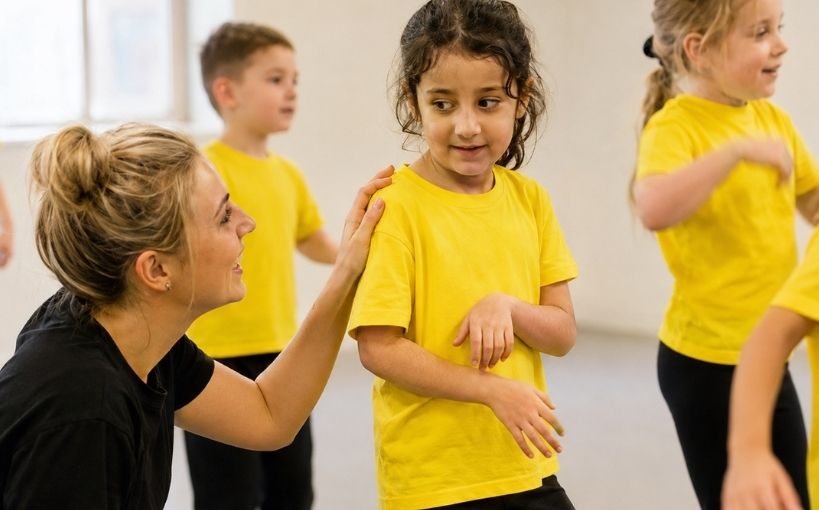
How experienced teachers welcome new students
A good first session does not throw children in at the deep end. It begins with something low-stakes and inclusive, where no one is singled out and no one is expected to perform. The structure is designed to help children feel part of the group before they are asked to do anything individually. At Stagecoach, for example, the performing arts classes for 4 to 6 year-olds are built around the principle that confidence comes before performance, not the other way around. Students are welcomed into a warm, structured environment where singing, dancing, and acting are taught as a group, with every child moving at their own pace. No child is put on the spot. The session is designed to feel like creative play, not an audition.
To prepare a child for a new activity, the most effective approach combines three things: telling them exactly what to expect before they arrive, practising a simple greeting or social script at home, and choosing a setting where the teachers are experienced at welcoming nervous beginners at their own pace. When all three are in place, most children settle far more quickly than their parents expect.
Why it is fine to watch before joining in
Some children need to observe before they participate. They need to watch how the group moves, listen to how the teacher speaks, and satisfy themselves that the environment is safe before they step into it. This is not a problem. It is a perfectly sensible way for a child to take in something new, and good teachers make space for it. Allowing a child to hang back and watch for a few minutes, before gently drawing them in, is a far more effective approach than insisting they join immediately. How confidence grows in children when the environment removes the fear of getting things wrong is directly connected to this: when children feel they have permission to observe and try at their own pace, the confidence that follows is genuine and lasting rather than performed.
For families with very young children or those who are particularly anxious about separation, it is also worth knowing that parent-accompanied performing arts sessions for younger children are available at Stagecoach for ages 2 to 4, where parents stay in the room throughout. That option removes the separation element entirely for children who are not yet ready for it.
After the First Session: What to Say and What to Watch For
The debrief after the first session matters almost as much as the preparation before it. How you respond to what your child tells you, and what you choose to ask, shapes how they feel about going back.
The question not to ask
“Did you enjoy it?” is a natural question, but it puts a child on the spot and invites a binary answer that may not reflect the complexity of what they experienced. A child who felt nervous, then interested, then a bit shy, then had one good moment, may not be able to summarise all of that as “yes” or “no.” Instead, try open, specific questions: “What did you do first?” “Was there anyone who made you laugh?” “What was the teacher like?” These questions invite the child to describe rather than evaluate, and they often reveal far more. They also give you something concrete to build on before the next session.
Signs your child is settling in
Positive adjustment does not always look like enthusiasm. A child who mentions a name, even briefly, is forming a connection. A child who asks a question about next week is thinking forward. A child who walks in slightly less reluctantly than the week before is building familiarity. These are the signs to look for, not a sudden transformation into someone who cannot wait to go. Most children begin to feel genuinely comfortable within two to three sessions, once the routine becomes predictable and a few faces become familiar. Pre-session nerves may persist longer than that, and that is completely normal. The nerves and the enjoyment are not mutually exclusive.
When to give it more time, and when to reassess
Consistency is the most powerful tool available to you in the early weeks. Attending regularly, even when nerves resurface, is what builds familiarity over time. That said, there is a difference between healthy anticipatory nerves and genuine, sustained distress. If your child is still very upset after several sessions, or if something specific seems to be causing the difficulty, it is worth a gentle conversation with the teacher. A good provider will welcome that conversation and work with you. And if, after giving it a genuine run, the activity simply is not the right fit, that is valuable information too. Not every activity suits every child, and trying something and deciding it is not for you is a lesson in self-knowledge, not a failure.
A confident next step
Ready to Take the First Step?
Starting something new takes courage, for children and for parents. The fact that you are reading this means you are already doing the most important thing: thinking carefully about how to help your child feel ready, rather than just hoping for the best.
At Stagecoach, we meet students exactly where they are. No prior experience is needed, no particular level of confidence is required, and no child is expected to perform before they feel ready. Our weekly performing arts classes that build confidence alongside creativity are designed to develop life skills, including communication, resilience, and teamwork, through singing, dancing, and acting in a warm, structured environment. We offer a Two-Week Trial for new families, so you can see how your child responds without any long-term commitment or pressure.
Find your local Stagecoach, choose a class and enrol in a two-week trial.
Common questions
FAQs about Helping Your Child Start a New Activity
My child is nervous about starting something new. How can I prepare them?
Start with an honest, calm conversation at home. Acknowledge that feeling a little nervous is completely normal and even a sign that they care about doing well. Talk through what to expect: who will be there, what they will do, how long it lasts. A short bit of role-play or visualisation, such as imagining walking in and seeing everyone smiling, can help a lot. Arriving a few minutes early on the first day gives them time to take in the space before the energy builds. Stagecoach recommends a step-by-step preview of the journey to the class, including where you will be waiting at the end, as one of the simplest and most effective ways to reduce a child’s anxiety before their first session.
What should I say to my child before their first session?
Keep it light and specific. Rather than “you’ll love it, don’t worry,” try something like: “Everyone there is learning too, and the teachers are brilliant at helping students feel welcome.” Validate their feelings without amplifying them. Saying “it’s okay to feel a bit wobbly, and I’ll be right here when you finish” gives them both permission to feel nervous and the reassurance that they are safe. Avoid leading questions such as “are you nervous?” which can plant anxiety where there was none. Open-ended questions, such as “what are you curious about?” work far better and invite your child to engage positively with the experience ahead.
How long does it usually take for a child to settle into a new group activity?
Every child is different, but most begin to feel comfortable within two to three sessions once they start recognising faces and understanding the routine. Some children take a little longer, and that is completely fine. Consistency is key: attending regularly, even when nerves resurface, is what builds familiarity and confidence over time. Pre-session nerves can persist even after a child is genuinely enjoying an activity, and that is entirely normal. If a child is still very distressed after several weeks, it is worth having a gentle conversation with the teacher, who will have seen this many times and can often offer practical reassurance or make small adjustments to the welcome process.
Should I stay and watch, or is it better to say goodbye and leave?
This depends on your child and the setting. For younger children especially, a confident, cheerful goodbye is often more helpful than a lingering farewell, which can unintentionally signal that there is something to worry about. When a parent hesitates or repeatedly checks in at the door, children often read that as a cue for anxiety rather than a cue for reassurance. Many providers will advise on their own approach. At Stagecoach, teachers are experienced at welcoming new students warmly and helping them feel part of the group from the very first session, so a brief handover to the teacher followed by a confident farewell is usually the most helpful approach.
What can I pack to help my child feel more comfortable on their first day?
A small, familiar comfort item tucked into their bag, such as a favourite keyring or a note from you, can offer quiet reassurance without drawing attention. Make sure they have had a snack beforehand, are dressed comfortably for the activity, and know exactly where you will be waiting. Practical preparation reduces the number of unknowns, and fewer unknowns mean less to worry about. It is also worth telling your child explicitly, not just once but twice, where you will be at the end of the session. That single piece of information can make an enormous difference to a child who is anxious about separation.
What if my child refuses to go in on the day?
Try not to match their anxiety with your own. Stay calm, crouch to their level, and remind them of one small thing they were looking forward to. A short, warm handover to the teacher rather than a prolonged goodbye can help move things forward without a standoff at the door. It is also worth remembering that a little resistance at the door is very common and rarely reflects how a child feels once they are inside and engaged. Most teachers have seen it many times and know exactly how to help. If the resistance is very strong, it can help to name the feeling calmly: “I can see you’re feeling worried. That makes sense. Let’s go in together and say hello.”
How do I know if the activity is the right fit for my child?
Look for signs of engagement rather than perfection. Does your child mention something they did or someone they met, even briefly? Do they seem a little more settled after a few sessions, even if they are still a bit nervous beforehand? A good provider will offer a trial period so you can make an informed decision without pressure. Stagecoach offers a Two-Week Trial for exactly this reason, giving families a low-commitment way to see whether it feels right for their child. The trial is designed to remove the financial and emotional pressure of committing upfront, so both parent and child can experience the class without the weight of a long-term decision hanging over the first session.
Is it normal for a child to be excited about an activity but still feel nervous before each session?
Absolutely. Pre-activity nerves and genuine enthusiasm are not mutually exclusive. Many children feel a flutter of anxiety before something they actually love, particularly if they are naturally sensitive or cautious in new situations. The Child Mind Institute notes that anxiety is not always a signal that something is wrong; it can simply be the brain’s way of preparing for something that matters [2]. Over time, as the environment becomes familiar and friendships form, those pre-session nerves tend to fade on their own. The goal is not to eliminate nerves entirely but to help your child feel capable of managing them, and to recognise that the feeling of nerves and the experience of enjoyment can, and very often do, exist side by side.
References
[1] Helping Young Children Who Are Socially Anxious by Katherine Martinelli
[2] 10 Tips for Parenting Anxious Kids by Grace Berman, LCSW


