
- Confidence & Child Development
- Parent Guides
Holiday Workshops: A Gentle Way In for Children Who Need a Little More Time
Some children take to new things with barely a backwards glance. Others need a little more time, a gentler entry point, and the reassurance that they are not locked in to anything before they have even had a chance to look around. If your child falls into the second camp, holiday drama workshops for children could be exactly the kind of low-stakes, high-reward experience they need. Stagecoach Performing Arts offers holiday workshops across the UK for children aged 4 to 18, with no term commitment, no uniform, and no expectation of prior experience. For a nervous child, a holiday workshop reduces several of the barriers that can make a new weekly activity feel daunting. Just a few days of singing, dancing, and acting in a creative, welcoming space, with a group of children who are all there for the same reason: to have fun and see what they can do.
Why the Holidays Are Actually the Perfect Time to Try Something New
For many children, the school year carries a weight that the holidays simply do not. There are no classroom dynamics to navigate, no friendship groups already formed, and no sense that everyone else already knows the rules. That psychological breathing room matters enormously when you are asking a child to try something unfamiliar. Stagecoach’s performing arts holiday workshops are designed with exactly this in mind: a contained, purposeful experience that sits outside the rhythms of school life and gives children space to simply be themselves.
Less pressure, more play
During the school term, children carry a lot. They are managing friendships, keeping up with learning, and navigating the social landscape of the classroom every single day. The school holidays strip much of that away. Children are more relaxed, more open to spontaneity, and far more willing to try things that might feel risky during term time. A holiday workshop meets them in that mood. The activities are structured enough to feel purposeful but playful enough to feel like a holiday, which is precisely the combination that helps a nervous child lower their guard.
For children who struggle with first-day nerves, the holiday context is genuinely helpful. There is no sense that this is a test or that anything is at stake. They come in, they play some games, they learn a song, and before long they are too busy having fun to remember they were nervous. That is not an accident. It is how Stagecoach approaches every session: creating an environment where children feel safe enough to take small creative risks, and where every small risk pays off.
A fresh group, a fresh start
One of the quiet advantages of a holiday workshop is that it brings together children from different schools, different neighbourhoods, and different social backgrounds. For a child who has struggled to find their place within their existing peer group, or who carries a particular social label at school, this is a genuine opportunity to start fresh. Nobody here knows them as "the shy one" or "the quiet one." They arrive as themselves, and they get to decide what version of themselves they want to show up as.
The social confidence children build before starting school, and in the early years of primary, often shapes how they navigate group situations for years afterwards. Stagecoach’s ethos is built on inclusivity: the aim is for every child to feel that they belong and can contribute. That principle is just as present in a five-day holiday workshop as it is in a full term of weekly classes.
What to Expect from a Stagecoach Holiday Workshop?
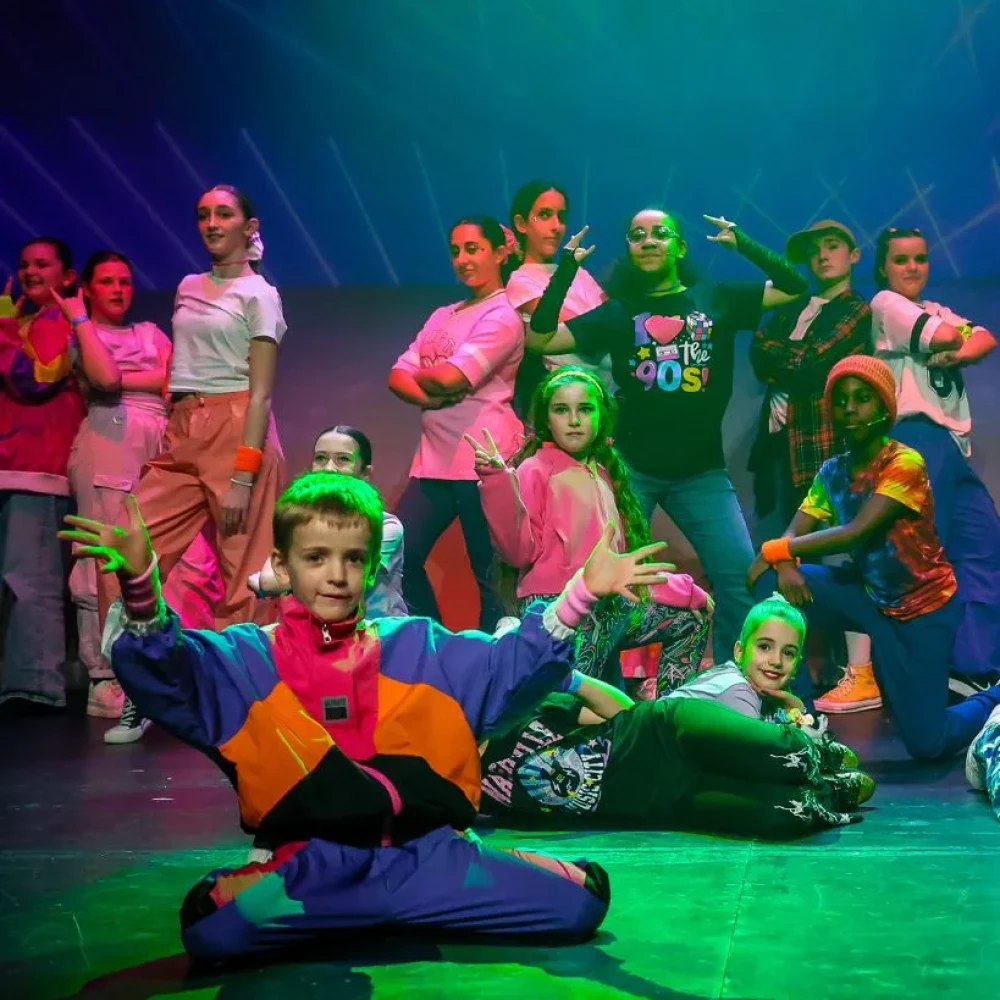
Stagecoach holiday workshops run during the main school holidays: Easter, summer, and half-terms, depending on your local school. Duration varies, but workshops typically run from a single day up to a full week. Children explore all three performing arts disciplines: singing, dancing, and acting, through a mix of structured activities, creative games, and rehearsals. Most workshops build towards a short performance at the end, giving children something to work towards and a real sense of achievement when they get there.
Singing, dancing, and acting: all three, all week
One of the things that makes a Stagecoach holiday workshop particularly well-suited to nervous children is the variety. There is no single discipline to feel intimidated by, and no expectation that a child will excel at everything. A child who is not yet confident enough to sing in front of others might throw themselves into a dance routine. A child who finds movement tricky might discover that they love making people laugh in an acting game. The breadth of activities means there is almost always something that clicks, and that moment of clicking, that first glimpse of "I can do this," is where confidence begins.
Sessions are led by qualified, experienced Stagecoach teachers who understand how children learn and how nerves work. They are skilled at reading a room and at gently drawing quieter children in without ever putting them on the spot. The approach is encouraging and focused on participation. Holiday drama workshops for children are at their most effective when the environment feels safe enough for every child to participate on their own terms, and that is precisely what Stagecoach teachers are trained to create.
The end-of-workshop performance
Most Stagecoach holiday workshops culminate in a short performance for family and friends. If that sentence just made you tense up on your child’s behalf, it is worth understanding what this actually looks like in practice. This is not a high-stakes show. It is a shared experience, rather than one child carrying the performance alone. It is a group experience, built collectively over the course of the workshop, and every child is part of it on their own terms.
For many children, this is the moment they surprise themselves most. They have spent the week rehearsing something they helped create, surrounded by children they now know and trust. By the time the performance arrives, most of them are not thinking about nerves at all. They are thinking about their moment on stage. For some children, realising they have taken part in something they once found daunting can be a small but significant turning point.
No experience, no uniform, no worries
Stagecoach holiday workshops are open to everyone. You do not need to be an existing Stagecoach student to attend, and your child does not need any background in singing, dancing, or acting. There is no uniform required, and children simply need to arrive in comfortable clothes they can move in. Workshops are age-appropriate, with sessions tailored to younger children (ages 4 to 6) and older children and teenagers (up to 18) so children can work alongside peers at a similar stage.
For parents, it helps to know that Stagecoach teachers are experienced in supporting children who need a little time to settle into a new group. You are welcome to speak to the team before the session starts if you have any concerns about your child, and ask how the team can best support them.
How Performing Arts Helps Nervous Children Build Confidence
There is a reason that performing arts has been used for decades as a tool for building confidence in children who struggle in group settings. It is not simply about putting children on a stage. It is about creating an environment where the normal rules of social risk are suspended, where making a mistake is part of the process rather than a source of shame, and where every child has a role to play that genuinely matters. Understanding how performing arts builds confidence in young children through play helps explain why so many parents of nervous children find that a single workshop changes their child’s relationship with group situations more broadly.
The magic of working towards something together
Ensemble work is particularly powerful for children who are prone to anxiety in social settings. When a group of children is working towards a shared goal, such as learning a routine or rehearsing a scene, the focus shifts away from the individual and onto the collective. A child who might feel exposed in a one-to-one social situation finds it much easier to participate when everyone is in it together. There is safety in the ensemble: you are not performing as yourself, you are performing as part of something bigger.
This is also why the end-of-workshop performance works so well for nervous children. It gives them a specific, achievable goal to focus on throughout the week. Rather than spending their mental energy worrying about whether they are fitting in, they are channelling it into something creative and purposeful. The worry does not disappear entirely, but it has somewhere useful to go.
Stagecoach’s approach to confidence-building is deliberate and progressive. Teachers introduce activities in a sequence that gradually raises the creative stakes, always within a safe and supportive framework. Activities can be introduced gradually within a supportive framework, giving children space to settle while encouraging them to try a little more.
What parents typically notice
Children respond to new experiences in different ways. Some settle quickly; others need more than one experience before they feel fully comfortable. But the combination of creative activity, peer connection, and genuine achievement creates conditions that are almost uniquely well-suited to helping shy children open up.
Parents often notice the effects beyond the workshop itself. A child who spent the week learning to project their voice in a singing session might start speaking up more at the dinner table. A child who navigated the social dynamics of a new group might find the playground a little less daunting the following week. These are not dramatic transformations. They are the small, cumulative shifts that add up to a more confident child over time.
From Workshop to Weekly Classes: There Is No Rush
A Stagecoach holiday workshop is a complete experience in its own right. Children can enjoy the creative work, the group and the sense of achievement without any ongoing commitment. That said, many families do find that a holiday workshop is the experience that tips the balance. A child who was uncertain about committing to weekly classes suddenly wants to know when they start.
If that happens, Stagecoach’s weekly performing arts classes for 4 to 6 year-olds run in term time and offer a Two-Week Trial, which means there is still no pressure to commit to a full term before your child has had a chance to settle in. Early Stages classes run for 90 minutes a week and cover all three disciplines in an age-appropriate, nurturing environment. For a child who has already had a positive holiday workshop experience, walking into their first Early Stages class feels a great deal less daunting than it might have done before.
For parents who want to understand the full range of what is available, Stagecoach offers age-appropriate performing arts classes from age 2 all the way through to adulthood. Every stage is designed to meet children where they are, developmentally and creatively, so there is never a sense that your child is being stretched too far too fast. The progression is built into the structure, and it happens at a pace that suits the child.
It is also worth remembering that the workshop itself has value entirely on its own terms. Not every child who attends a Stagecoach holiday workshop will go on to join regular classes, and that is completely fine. The confidence, the friendships, and the experience of achieving something creative do not expire when the workshop ends. They go home with your child, and they stay.
When the time feels right
Find a holiday workshop near you
Workshop dates and formats are arranged locally, so what is available will depend on your nearest Stagecoach school.
You can browse nearby schools, view current details and contact the local team if you would like to talk through whether a workshop could suit your child.
Questions parents often ask
FAQs about Stagecoach Holiday Workshops for Children
Are holiday drama workshops a good first step for shy or nervous children before committing to regular classes?
Yes, and that is exactly what makes them so well suited to hesitant children. A holiday workshop is a self-contained, low-pressure experience: there is no term-long commitment, no uniform required, and no expectation of prior experience. Children arrive, get creative and work with the group; depending on the workshop, they may also share what they have made in a short performance. For a child who finds new situations daunting, that kind of positive first experience can make all the difference when it comes to deciding whether to join regular classes. Stagecoach teachers are experienced in supporting children through first-day nerves, and the emphasis remains on taking part as a group.
My child is quite shy. Will they be pushed to perform in front of others?
Not at all. Stagecoach’s approach is built on the understanding that confidence is something you build gradually, not something you switch on. Teachers create a warm, inclusive environment where children are encouraged gently and entirely at their own pace. The end-of-workshop performance is a shared group experience: every child is part of it, but no child carries it alone. The emphasis is on taking part together, rather than placing the whole performance on one child. As the group becomes more familiar, a child can focus less on the unknown and more on taking part in what they have created together.
What age groups are Stagecoach holiday workshops suitable for?
Stagecoach holiday workshops are open to children and young people aged 4 to 18. Younger children in the 4 to 6 age range take part in age-appropriate sessions with plenty of games, songs, and storytelling to ease them in gently, while older children and teenagers work on more structured musical theatre material. Sessions are grouped by age so that every child is always working alongside peers at a similar stage, both socially and creatively. You do not need to be an existing Stagecoach student to attend, and no uniform is required. Holiday workshops are specifically designed to be welcoming for first-timers, so even if your child has never done anything like this before, they will be in exactly the right place.
What actually happens during a Stagecoach holiday workshop?
Workshops typically run for anywhere from a single day to a full week, depending on your local Stagecoach school. During that time, children explore all three performing arts disciplines: singing, dancing, and acting, through a combination of creative games, structured activities, and rehearsals. Most workshops build towards a short performance at the end, giving children a clear goal to work towards and a genuine sense of achievement when they get there. The balance between structure and playfulness is deliberate: sessions feel purposeful without feeling like hard work. For children who need variety to stay engaged and to feel comfortable, the mix of disciplines means there is almost always something that captures their imagination and gives them a foothold.
Do children need any previous experience in singing, dancing, or acting to join a holiday workshop?
No experience is needed at all. Stagecoach holiday workshops are designed to be fully welcoming for complete beginners. Children learn through doing, and Stagecoach teachers are skilled at bringing everyone along together, regardless of starting point. Activities are introduced progressively so that children build on each small success before moving to the next challenge. If your child has never set foot on a stage before, or has never tried any kind of performing arts activity, that is absolutely fine. A first workshop can simply give a child the space to discover whether they enjoy it.
Can a holiday workshop help my child make friends?
It really can. One of the things that makes performing arts such a brilliant environment for children is the natural, organic way it brings people together. Working towards a shared goal, whether that is learning a dance routine or rehearsing a scene, gives children an immediate, low-pressure reason to connect with one another. There is no awkward moment of "go and introduce yourself" because the activity does the work for them. Many parents tell us that their child came home from a Stagecoach holiday workshop having made a genuine new friend, even after just a few days. For children who find the social side of new environments the most daunting part, this is often the most meaningful outcome of the whole experience.
How is a holiday workshop different from Stagecoach’s regular term-time classes?
Stagecoach’s term-time classes run weekly across the school year, helping students build skills progressively across singing, dancing and acting in a consistent, familiar group. Holiday workshops are shorter, self-contained, and open to anyone: you do not need to be a regular Stagecoach student, and there is no ongoing commitment involved. Think of a workshop as a brilliant standalone experience in its own right, but also a natural way to see whether your child would love to join regular classes. Many families use a holiday workshop as a trial run before enrolling in term-time classes, and Stagecoach’s Early Stages classes for 4 to 6 year-olds also offer a Two-Week Trial for families who want a little more time before committing.
What if my child gets upset or wants to leave during the workshop?
First-day nerves are completely normal, and Stagecoach teachers are trained to support children through them with patience and care. The team can reassure a child who needs a moment, and the session structure is designed to help children settle in gradually rather than throwing them in at the deep end. Parents are always welcome to speak to the team before the session starts to share anything that would help the teachers support their child better. Speak to your local Stagecoach team about how they support children and keep parents informed. Many children who arrive feeling uncertain finish with a genuine sense of pride in what they have achieved.


