

- Research & Insights
Top Performing Arts And Drama Classes Buyers Guide Statistics: UK 2026
What do UK parents look for when choosing performing arts and drama classes? We analysed 68,841 online opinions to identify the disciplines, provider qualities, enrolment methods and practical considerations shaping decisions in 2026.
Parents are putting more thought than ever into how their children spend time outside the classroom, and performing arts is firmly on the shortlist. From dance and drama to singing, musical theatre, and other creative kids’ activities, families are weighing confidence-building, creativity, teaching quality, and long-term development alongside practical considerations like cost, location, and convenience.
To find out what 68,841 opinions of parents in the UK were about investing in performing arts and drama classes for their children, we utilised AI-driven audience profiling to synthesise insights from online discussions over 12 months, ending on June 10th, 2026, to a high statistical confidence level. What we found were supportive parents, trust in the recommendations of family and friends, some uncertainties about the stage schools they found, suggestions for improvement, and a good understanding of the different ways stage school can benefit their children.
Index
- Dance and movement is 30% of parents’ children’s absolute favourite performing arts discipline, while 25% show a strong interest in it, 16% are very interested in singing and musical theatre, while it’s a favourite for 26%, and 2% of children might consider it
- 55% of parents spend most of their time researching performing arts class options on the provider’s own website and social media channels before making a decision, and 45% spend time looking at Google search results and review platforms such as Trustpilot and Google Reviews
- An uncertainty about whether their child’s age or ability is catered for is the biggest challenge for 39% of parents when trying to find the right performing arts classes in their area, 26% have difficulty assessing teaching quality before committing, 18% battle with paying high fees without really knowing what’s included, and another 18% struggle as there are limited class options available locally
- A nurturing environment that builds confidence, not just performance skills, is absolutely essential for 33% of parents when evaluating a performing arts provider for their child, 23% agree that qualified, experienced, and DBS-checked teachers are very important, and 44% feel the same about a structured curriculum covering singing, dancing, and acting
- 78% of parents prefer to sign their children up with a performing arts academy after a showcase or public performance, and 22% prefer to enrol their child using an online booking system directly through the provider’s website
- For 81% of parents, more performance opportunities and end-of-term showcases would make a huge difference in enhancing their experience with their current or previous performing arts provider, while 7% agree this would be a nice improvement, 10% would love a stronger focus on building life skills like confidence and teamwork, and a further 2% agree this would be a nice improvement
- 81% of parents would consider online performing arts and drama classes for their child if it meant that they would avoid travel altogether, while 19% feel that distance is not a barrier if the quality of the learning environment is right
- 61% of parents in our audience are single parents, 37% are working and are either employed or self-employed, and just 2% are stay-at-home parents or are the full-time carers
- 88% of parents work in the creative or arts industry, which explains their interest in encouraging their children’s creativity, 11% are in hospitality or other services, and 1% work in or most closely identify with the business, finance, or technology industry
- Liverpool is home to 41% of parents, Birmingham to 35%, 19% of parents are from Edinburgh, 3% from London, and 2% live in Manchester
- Strong support for the performing arts remains despite the STEM focus
- About the data
Which performing arts discipline are parents’ children most interested in pursuing?
Dance and movement is 30% of parents’ children’s absolute favourite performing arts discipline, while 25% show a strong interest in it, 16% are very interested in singing and musical theatre, while it’s a favourite for 26%, and 2% of children might consider it
Interests in performing arts disciplines are split into two categories:
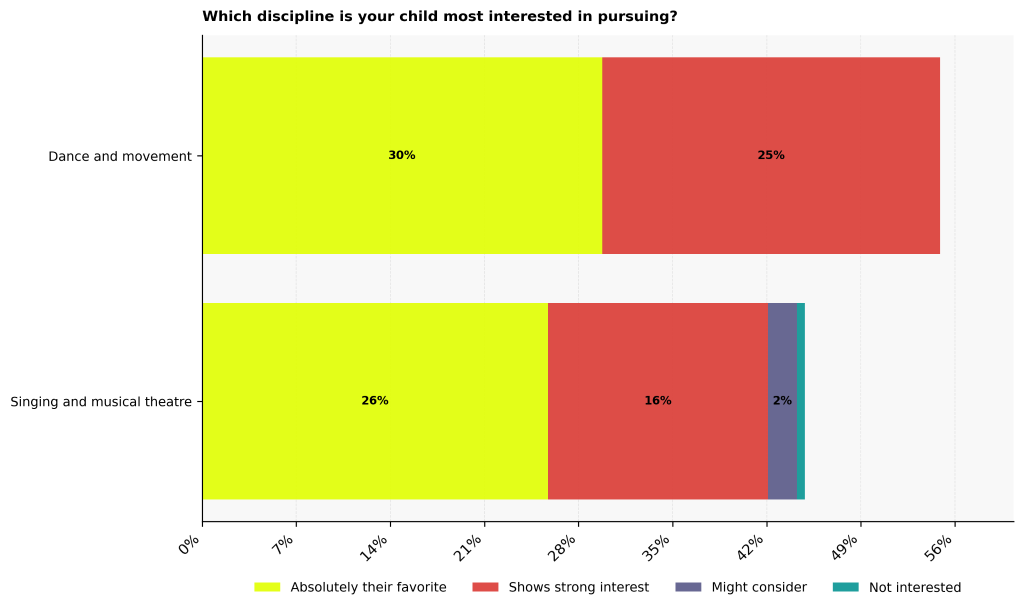
More than half of our audience indicates that their children have varying degrees of interest in dance and movement. 30% of parents say this is the performing arts discipline their children are most interested in pursuing, as it’s absolutely their favourite. Additionally, the children of 25% of parents show a strong interest in it.
This is an interest that should be encouraged, as dance can benefit children’s development in various ways. One study found that dance increased their self-confidence and supported physical and mental growth, especially in terms of agency, confidence, and participation.
Children who participated in the dance intervention engaged in activities more eagerly, overcame language barriers to self-expression, and reported higher levels of enjoyment and satisfaction. Lastly, they became more vocal about their needs, more confident in approaching adults, exhibited greater responsibility for their actions, and were more willing to support other children in doing the same.
As for the rest of our audience, singing and musical theatre is absolutely the favourite performing arts discipline of the children of 26%, while those of 16% show strong interest, and those of 2% might consider it. The remaining less than 1% barely discussed it or opined that their children aren’t interested.
Stagecoach offers all of these disciplines, and (person) (role at Stagecoach) explains, “With more than 35 years of experience since its founding in 1988, Stagecoach has grown into one of the world’s largest part-time performing arts schools, inspiring over 60,000 students every week across 3,000 schools and classes. Our long-standing reputation, structured programmes, and global network of more than 300 franchisees make it a trusted choice for parents looking to build confidence, creativity, and performance skills in their children.”
How do parents search for performing arts and drama classes for their child?
60% of parents typically begin their search for performing arts and drama classes for their child by asking parents or friends for recommendations, while 40% browse social media groups and parenting forums for references
Real life and online recommendations lead the way:
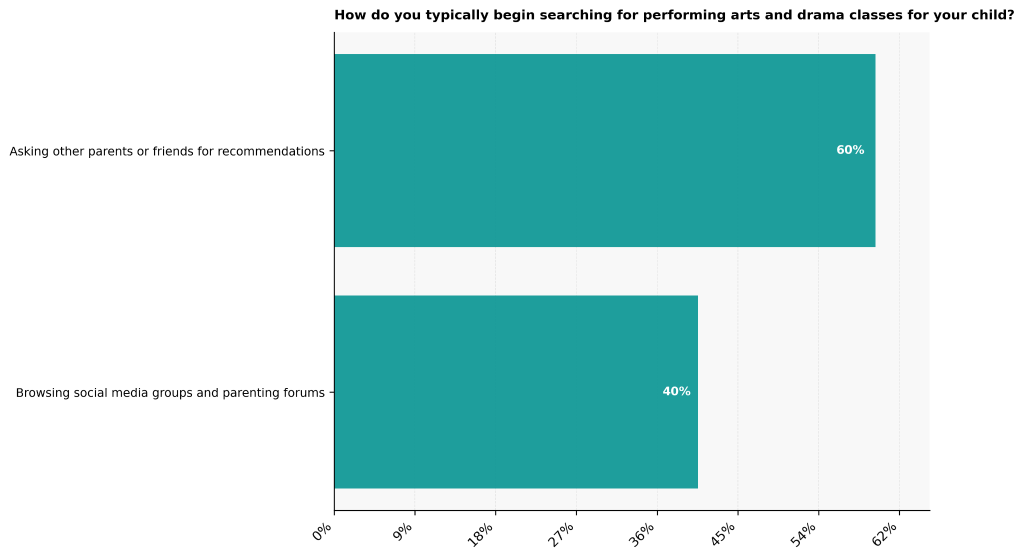
Not all performing arts and drama classes are created equal. Some impart valuable skills and open doors to exciting opportunities, while others are a waste of time and money, which is why it’s important for parents to find reputable classes or institutions. 60% of parents weighed in about asking other parents or friends for recommendations.
This isn’t surprising, as 89% of consumers trust recommendations from people they know above all other advertising channels, highlighting the importance of authenticity and personal connection. One of the reasons for this comes down to social proof – if others are doing it, there must be something to it. The experiences of others can help reduce uncertainty or perceived risk, while those of authority figures or perceived experts transfer trust from those figures to the brand or service they recommend. There’s also a link between social proof and the bandwagon effect, in that people often feel safer when making choices in line with group behaviour.
The remaining 40% posted about browsing social media groups and parenting forums when they start searching for classes for their children. This isn’t entirely different from the other parents’ approach, as it also draws on word-of-mouth advertising, recommendations, and (often) personal experience.
Where do parents research performing arts and drama class options before making a decision?
55% of parents spend most of their time researching performing arts class options on the provider’s own website and social media channels before making a decision, and 45% spend time looking at Google search results and review platforms such as Trustpilot and Google Reviews
Research options prior to decision-making are all online:
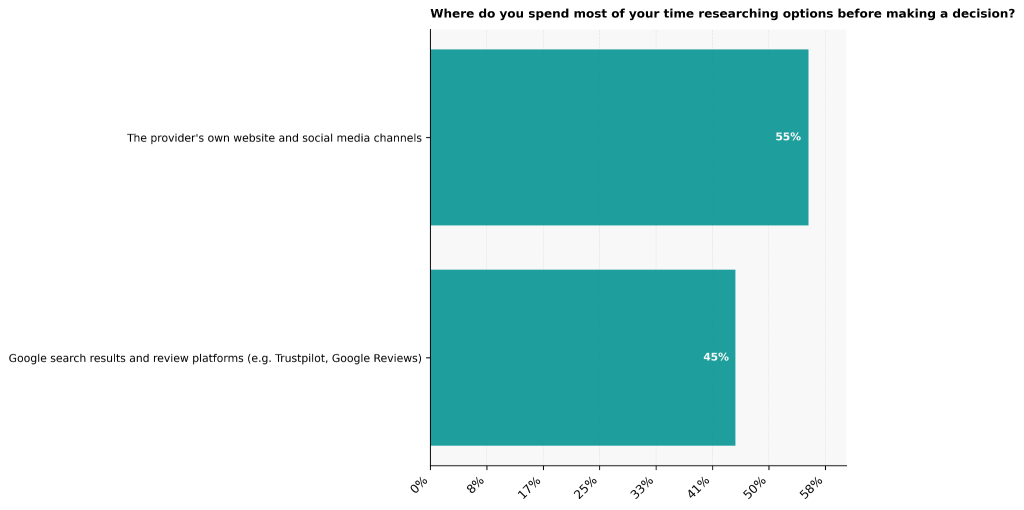
Once parents have a list of options, they need to research them before deciding which performing arts and drama class to send their child to. 55% go to the source, browsing the provider’s own website and social media channels. In most cases, this enables them to see what the provider does and to see reactions and read reviews and comments from parents whose children are members of those classes and from community members.
45% mention using Google search results and review platforms such as Google Reviews and Trustpilot to research options. This ties in with what we saw above about parents relying on social media groups and parenting forums, indicating a lack of trust in traditional marketing. Rather than taking the class organisers at their word, these parents want to know what other parents’ experiences have been.
What is parents’ biggest challenge when finding the right drama classes in their area?
An uncertainty about whether their child’s age or ability is catered for is the biggest challenge for 39% of parents when trying to find the right performing arts classes in their area, 26% have difficulty assessing teaching quality before committing, 18% battle with paying high fees without really knowing what’s included, and another 18% struggle as there are limited class options available locally
Challenges when finding classes vary:
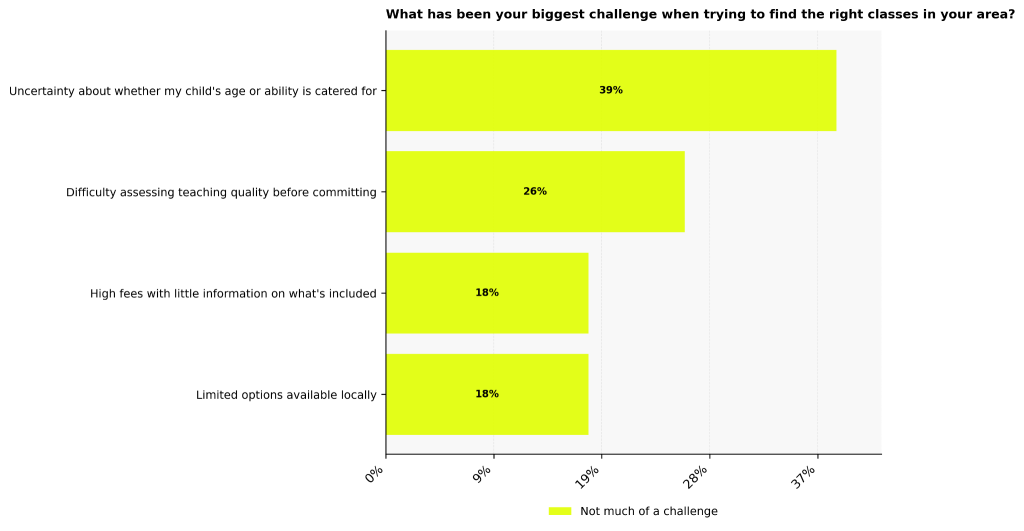
Despite the recommendations of family, friends, and online reviews or social media groups, parents still face challenges when trying to find the right drama classes close to home. 39% spoke about uncertainties around whether the classes catered to their child’s age or ability. These uncertainties may be due to these parents receiving recommendations from friends or family whose children are in different age groups, unclear information published on providers’ websites, or social media posts focused on children in other age groups or of other abilities.
26% have difficulty assessing the quality of teaching before committing to send their child to drama classes in their area, with 18% having an issue with classes that charge high fees without providing much information about what’s included. These could be classes found through social media forums or search platforms such as Google, and those with sparse websites.
Some of these challenges may stem from parents not knowing what to consider when looking for performing arts schools in their area. A few tips that can help parents assess schools, teaching quality, and what’s included in the fees are paying attention to how close the school is to home, researching the curriculum to determine whether it caters to your child’s interests, age, abilities, and learning style, taking note of the Ofsted or other agency ratings, and evaluating the extracurricular activities.
It’s also worth contacting the school for more information and to arrange a visit, allowing you to get a sense of its culture and values. When browsing the school website, look for information regarding the current retention rate, student and artist visibility, and, if applicable, performance ticket sales.
Another 18% posted about limited options in their area. This implies that the available local options may not cater to their child’s age, ability, or interests, or have a good reputation.
What is the most important quality parents look for when evaluating a performing arts school for their child?
A nurturing environment that builds confidence, not just performance skills, is absolutely essential for 33% of parents when evaluating a performing arts provider for their child, 23% agree that qualified, experienced, and DBS-checked teachers are very important, and 44% feel the same about a structured curriculum covering singing, dancing, and acting
Provider qualities are crucial to the selection process:
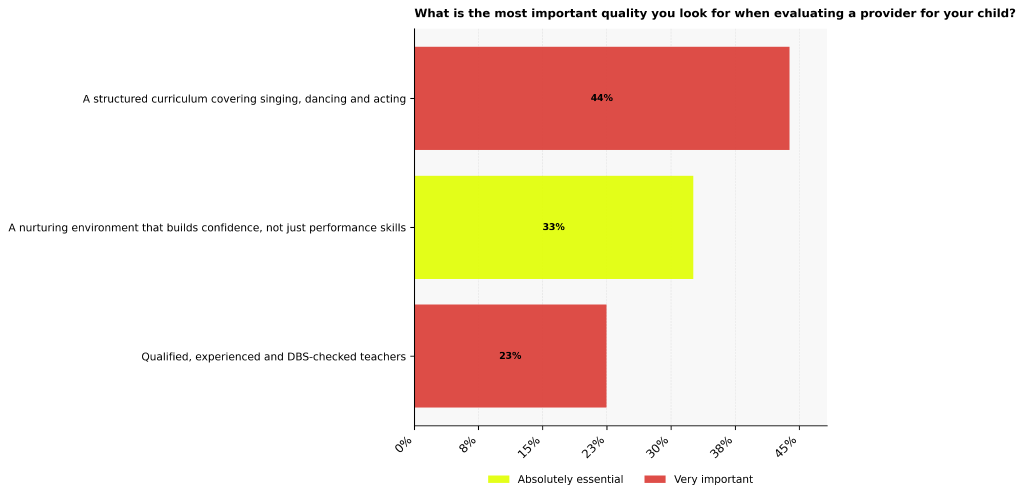
Parents have different priorities or requirements when evaluating performing arts schools for their child. 44% of conversations highlighted a structured curriculum covering singing, dancing, and acting as very important. For this segment, the focus is on finding a school that offers an all-around approach to the performing arts, exposing children to a variety of disciplines and enabling them to find their niche.
33% of parents’ discussions make it clear that a nurturing environment that builds confidence in addition to performance skills is an absolutely essential quality. This ties in with the above research showing how dance (and, possibly, by extension, other performing arts) benefits children in terms of mental and physical growth and self-confidence. 23% of parents think qualified, experienced, and DBS-checked teachers are very important. They want assurance that they’re making a good investment in their child’s education and that their child is safe.
As different as these three segments’ sentiments are from each other, they point to parents who are supportive of their child’s educational journey. This is commendable, as research found that parental involvement in a child’s artistic education is vital for their development and for strengthening family ties. Additionally, children aren’t the only ones to benefit from this involvement. Active involvement sees parents develop their own skills by playing a role in passing on knowledge.
How do parents prefer to enrol their child in a performing arts academy?
78% of parents prefer to sign their children up with a performing arts academy after a showcase or public performance, and 22% prefer to enrol their child using an online booking system directly through the provider’s website
Public performances play a major role in enrolment choices:
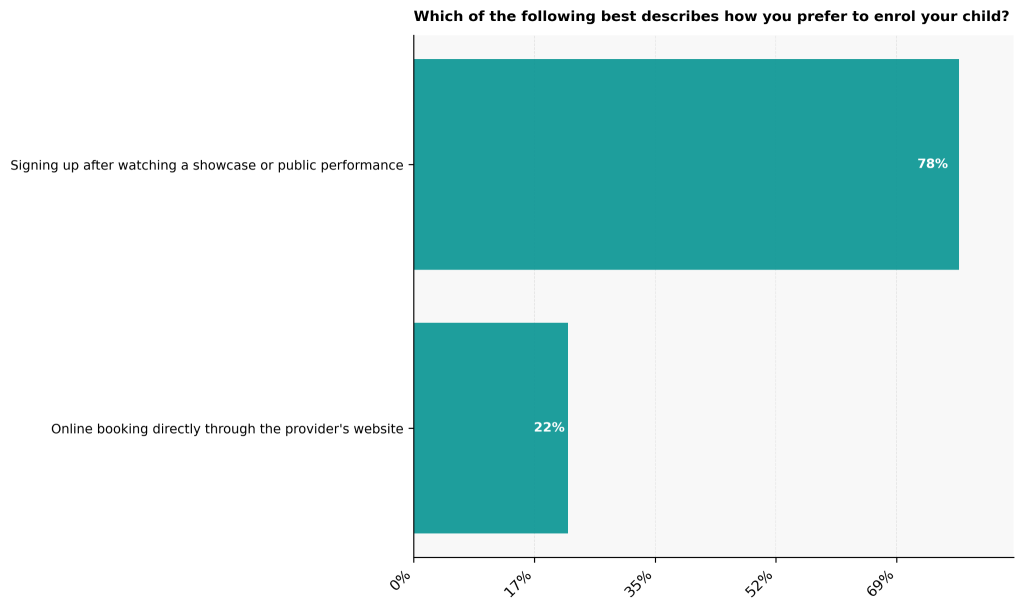
Approaches to enrolment also differ among parents, with 78% talking about signing their child up after watching a showcase or public performance. It makes sense that many parents see a showcase or performance as the final litmus test. While allowing for varying degrees of talent among those involved, watching a performance by children from different classes or years provides insight into the school’s standards.
The remaining 22% discussed using online booking directly through the provider’s website when enrolling their child in performing arts and drama classes. Parents who prefer this approach either feel confident enough in their choice to forego a public performance or showcase, or they had previously seen a performance by students attending those classes.
What would improve parents’ experience with their current or previous stage school?
For 81% of parents, more performance opportunities and end-of-term showcases would make a huge difference in enhancing their experience with their current or previous performing arts provider, while 7% agree this would be a nice improvement, 10% would love a stronger focus on building life skills like confidence and teamwork, and a further 2% agree this would be a nice improvement
There is room for improvement in providers:
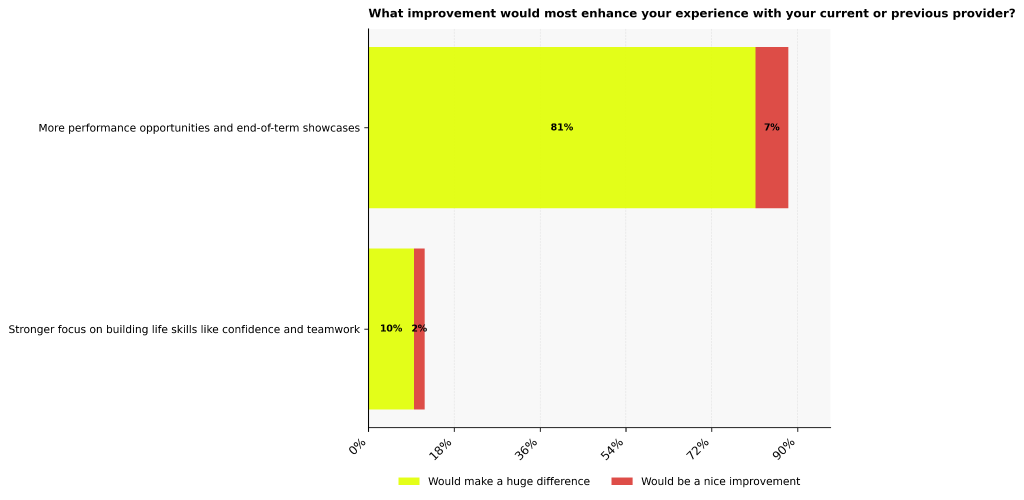
Given their posts, many parents either have or have had a child attending a stage school, giving them valuable insights into how their experience with these schools can be improved. For 81%, more performance opportunities for the children and more end-of-term showcases would make a huge difference. 7% have a somewhat similar opinion, saying this would be a nice improvement. Among these are parents who feel their child doesn’t get enough experience performing for an audience, while others aren’t satisfied with an end-of-term report card only – they also want to see the results for themselves, as it were.
10% of discussions reveal that a stronger focus on building life skills, such as confidence and teamwork, would make a huge difference, while 2% indicate that this would be a nice improvement on their current or past experience. For these parents, the benefits of arts and drama classes aren’t limited to their children learning various artistic disciplines.
Various studies have found that children who are involved in the performing arts are more likely to be recognised for academic achievement and demonstrate enhanced cognitive, motor, and social development. These children learn to think on their feet, especially when it comes to minimising errors or going with the flow. They also learn how to master their anxiety, take ownership of different emotions, and express themselves in ways they’re not comfortable doing around some of their peers. As a result, children grow in self-esteem and learn to see the world in a new way by applying some of the skills they learned in arts and drama classes in other situations.
How far are parents willing to travel to reach their child’s stage classes?
81% of parents would consider online performing arts and drama classes for their child if it meant that they would avoid travel altogether, while 19% feel that distance is not a barrier if the quality of the learning environment is right
Most parents would prefer to eliminate travel:
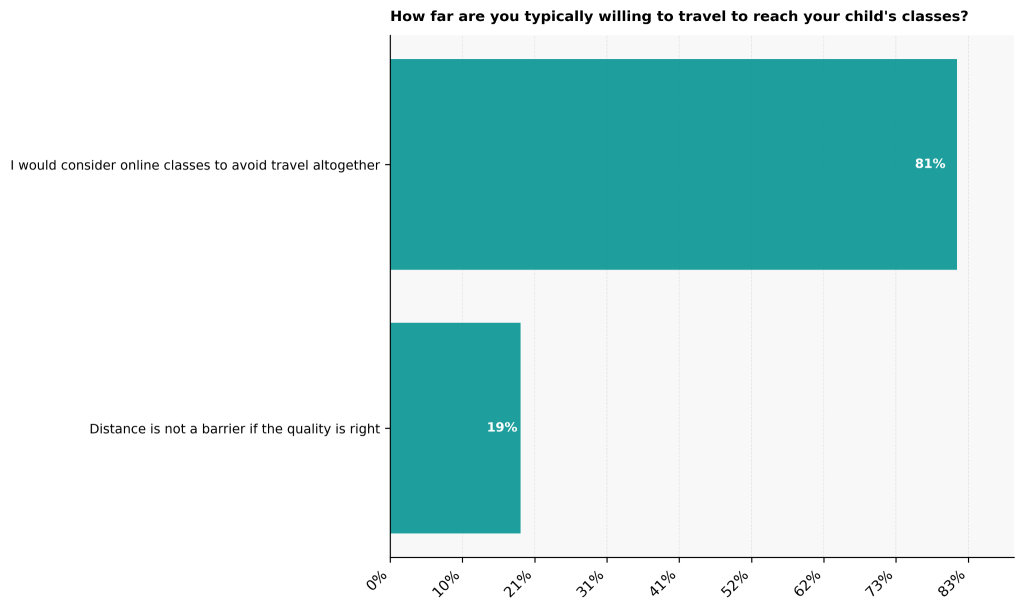
One of the most surprising insights we gained from parents’ online discussions involves the distances they would be willing to travel to reach their child’s arts and drama classes. For all the support we’ve seen thus far – and for the awareness around the benefits of these classes for children – the majority of parents don’t seem to like the idea of travelling to classes. 81% of posts on this topic reveal that parents would consider online classes to avoid travelling altogether.
In some cases, online classes are the only viable option, and they do have their strong points. Online classes are a more sustainable option for some schools as they’re accessible, and parents can watch classes along with their child. However, in-person classes provide physical spatial freedom, real-time tactile corrections, opportunities to build stage presence, use props and other equipment not necessarily available at home, and interact and collaborate with peers.
The remaining 19% have a vastly different opinion, as they speak about how distance isn’t a barrier if the quality of their child’s stage classes is right. These parents are keen to ensure their child receives a good quality performing arts education in a supportive setting, which tells us they have at least some understanding of the benefits of in-person classes.
What is the current job title or role of parents?
61% of parents in our audience are single parents, 37% are working and are either employed or self-employed, and just 2% are stay-at-home parents or are the full-time carers
Clear patterns emerge in parenting jobs and roles:
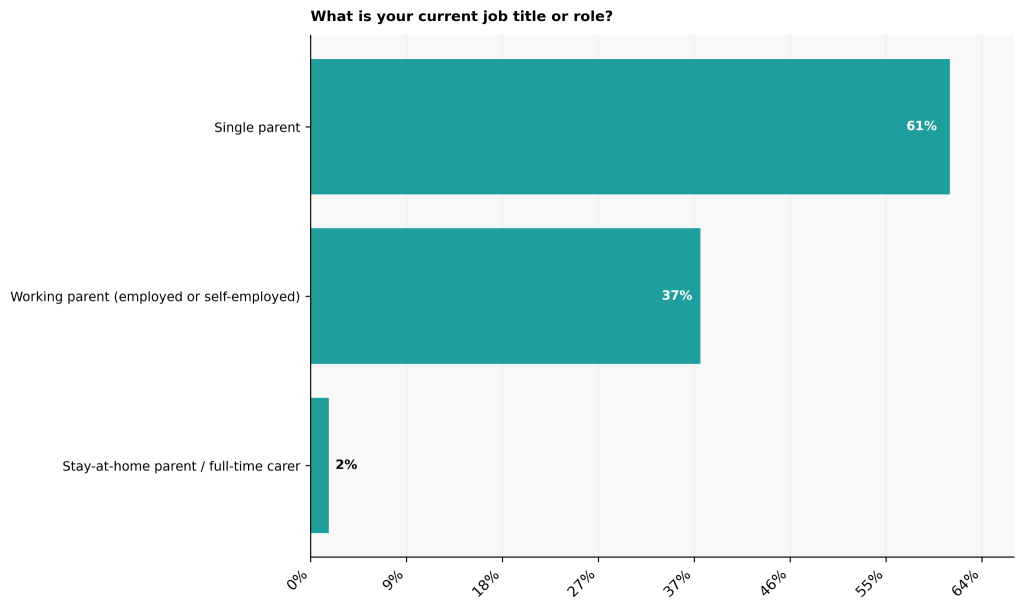
Our audience includes parents from different backgrounds, with 61% being single parents. Once a minority among family groups, lone-parent families in the UK are increasing. According to the Office for National Statistics, the number of lone-parent families increased from 3 million in 2014 to 3.2 million in 2024, with these most likely to be lone fathers with at least one dependent child. To put this in perspective, the total number of families in the UK that year was estimated at 19.7 million.
37% of our audience describe themselves as working parents who are either employed or self-employed, while just 2% are stay-at-home parents or full-time carers. The large number of single and working parents may be why so many would prefer online classes if they eliminated travel, as travel is time-consuming and not always easy to plan.
Which industry do parents currently work in or most closely identify with?
88% of parents work in the creative or arts industry, which explains their interest in encouraging their children’s creativity, 11% are in hospitality or other services, and 1% work in or most closely identify with the business, finance, or technology industry
The majority of parents are in creative fields:
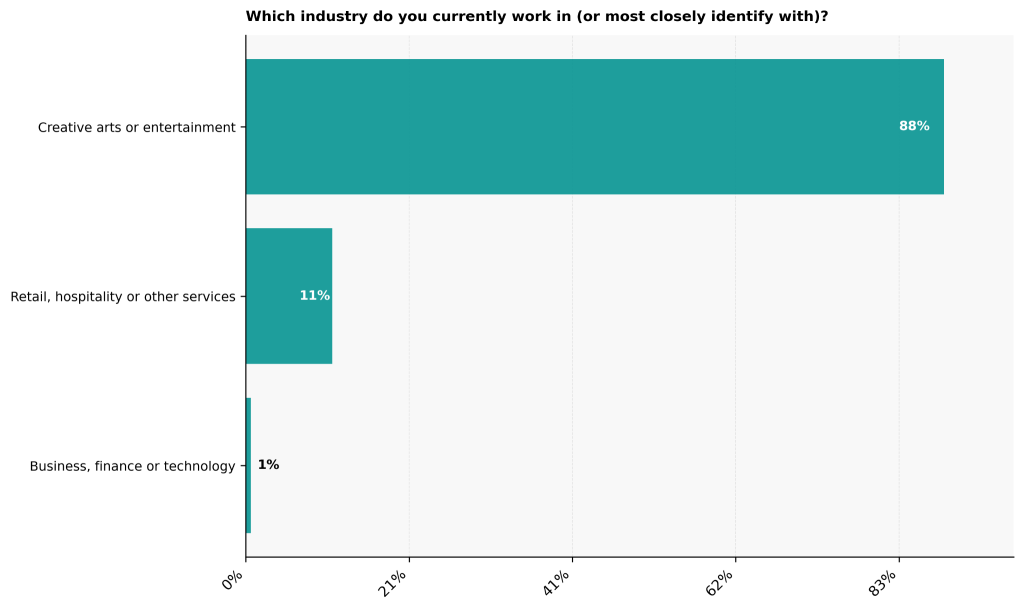
In terms of the industry parents currently work in or most closely identify with, 88% of discussions mention the creative arts or entertainment industry. This helps explain the specific qualities parents look for in stage schools and the familiarity or understanding a significant portion of our audience has regarding the different benefits of performing arts and drama classes for children.
11% of parents work in retail, hospitality, or other services, while only 1% of online posts or discussions mention the business, finance, or technology industries.
Which city or town are parents based in?
Liverpool is home to 41% of parents, Birmingham to 35%, 19% of parents are from Edinburgh, 3% from London, and 2% live in Manchester
Parents in our audience live across the UK:
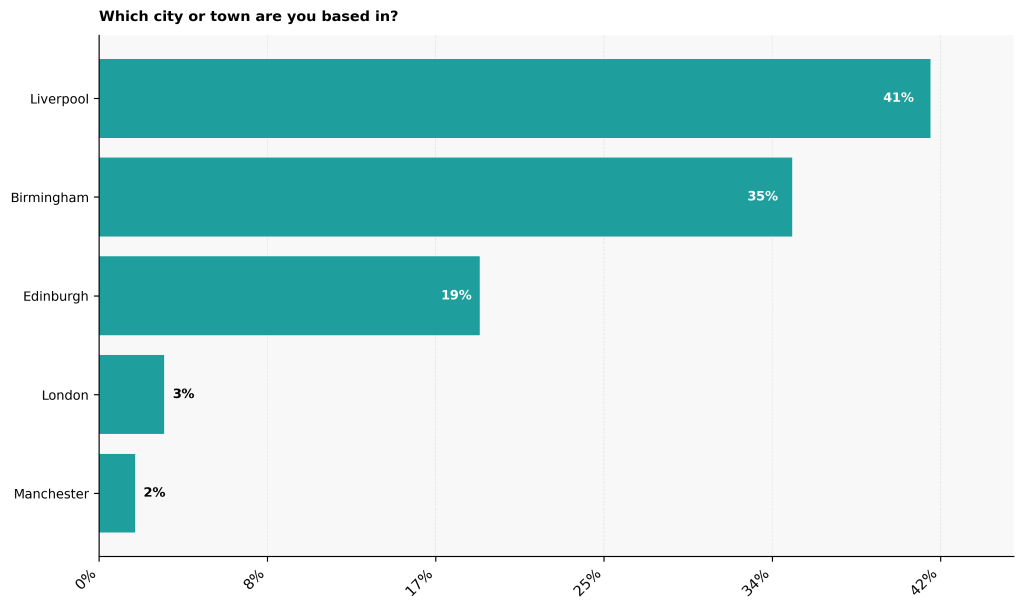
Almost 41% of our audience is currently based in Liverpool, a UNESCO City of Music. Of course, as any Liverpudlian would tell you, art and culture in the city extend far beyond music to include dance, theatre, and much more. 35% are currently based in Birmingham, while 19% are in Edinburgh, famous for a performing arts scene that culminates in the world-famous Edinburgh International Festival and Edinburgh Festival Fringe.
Only 3% of discussions mention London, which caught us by surprise. Recent data ranks London above New York City as one of the best cities for a theatre break, based on the number of shows, theatres, and ticket prices. The implication here is that children and parents in the capital may be more likely to be exposed to a greater variety and a higher standard of the performing arts, which potentially would inspire more of them to consider stage school. The remaining 2% of discussions refer to Manchester as the city where parents are currently based.
Strong support for the performing arts remains despite the STEM focus
These statistics reveal much about parents’ approaches to finding the top performing arts and drama classes in the UK. With most children interested in dance and movement classes, parents turn to those they can trust for stage school recommendations.
Even though they ask friends, family, or social media groups or forums for suggestions, most of our audience have a good idea of the qualities to look for in a stage school and how to assess them, even if they still have a few uncertainties. Of concern is the large number of parents who lean toward enrolling their child in online classes, as these do not offer all the benefits of in-person classes. That said, it’s encouraging to see that, at a time when STEM subjects are being pushed as the way forward, so many parents are willing to support children who are interested in learning the performing arts.
About the data
Sourced using Push from an independent sample of 68,841 opinions of parents in the UK across X, Quora, Reddit, Bluesky, TikTok, and Threads. Responses are collected within a 95% confidence interval and 5% margin of error. Results are derived from what people describe online, from opinions expressed, not actual questions answered by people in the sample.
Find Your Local School