
- Research
Kids Activity Classes Statistics: UK 2026
Discover what 47,632 opinions of parents are about kids activity classes in the UK. New statistics paint an interesting picture of current preferences.
Kids Activity Classes Statistics: UK 2026
Kids’ activity classes have moved beyond being simple after-school fillers. For many of us, they shape how our children build confidence, explore new interests, and spend their time outside the classroom. Creative pursuits, from sports to performing arts, allow children to experiment, take risks, and discover abilities they might not realise they have.
But choosing the right class now involves more than picking a convenient slot. Teaching quality, class environment, flexibility, and communication are all considered, as are fitting sessions around demanding work schedules and family routines.
To find out what 47,632 opinions of parents in the UK were about kids’ activity classes, we utilised AI-driven audience profiling to synthesise insights from online discussions over 12 full months ending 16 February 2026, to a high statistical confidence level. These perspectives show how we compare options, manage commitments, and decide which classes genuinely work for our children and our everyday lives.
Index
- 51% of UK parents say that encouraging creativity is their top priority when choosing a kids’ activity class
- 67% of UK parents say that the pandemic had no significant change in attitude toward enrolling their child in activity classes
- Dance and movement is the top choice for 32% of parents interested in kids’ activity classes
- 40% of parents in the UK considering kids’ activity classes say their children are in their early years
- There’s a 50/50 split in parents who prefer an energetic and dynamic class environment and a supportive and nurturing one
- 75% of UK parents say that performance or showcase opportunities are not a priority in kids’ activity classes
- 85% of parents in the UK discover new kids’ activity classes on social media
- 100% of UK parents evaluate the credibility of a kids’ activity class provider by online reviews
- For 48% of UK parents, the class environment is the top concern when evaluating a provider
- 100% of UK parents say that the quality of instructors has a strong influence on their decision about a kids’ activity class
- A more convenient location would only encourage 16% of parents to switch to a new kids’ activity class provider
- 35% of parents say that holiday workshops are their ideal choice from a class provider
- 55% of UK parents say they prefer to book a kids’ activity class on an online booking platform
- 100% of parents find feedback after every session an extremely valuable form of communication from a class provider
- 56% of UK parents in our audience work in the healthcare sector
- 39% of UK parents enrolling their kids in activity classes are based in Leeds
- What Parents Really Look For in Kids’ Classes
- About The Data
What Is Your Main Goal When Choosing A Kids Activity Class?
51% of UK parents say that encouraging creativity is their top priority when choosing a kids’ activity class
Parents juggle multiple priorities when choosing activities:
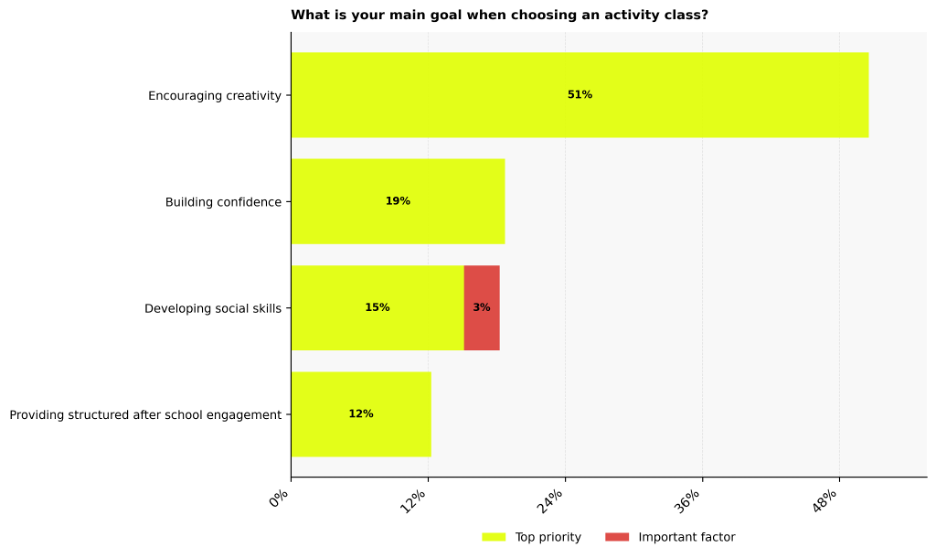
The main goal when choosing a kids’ activity class for parents in the UK centres most strongly on encouraging creativity, with 51% naming it as their top priority. This focus comes from a shared belief that creative play supports how children think, adapt, and solve problems as they grow. Research into childhood creativity links early creative development to stronger educational outcomes, better career prospects, and higher long-term earnings, reinforcing why so many parents place it first.
Building confidence follows as a top priority for 19%, showing how much value we place on children learning to express themselves, take initiative, and feel comfortable in new situations. Developing social skills also matters, with 15% treating it as a top priority and a further 3% viewing it as an important factor, reinforcing the role of teamwork and communication in everyday learning. Meanwhile, 12% prioritise structured after-school engagement, pointing to our shared desire for routines that balance fun, focus, and emotional security.
How Has Covid Influenced Your Attitude Toward Enrolling Your Child In Activity Classes?
67% of UK parents say that the pandemic had no significant change in attitude toward enrolling their child in activity classes
The pandemic had a surprisingly limited impact:
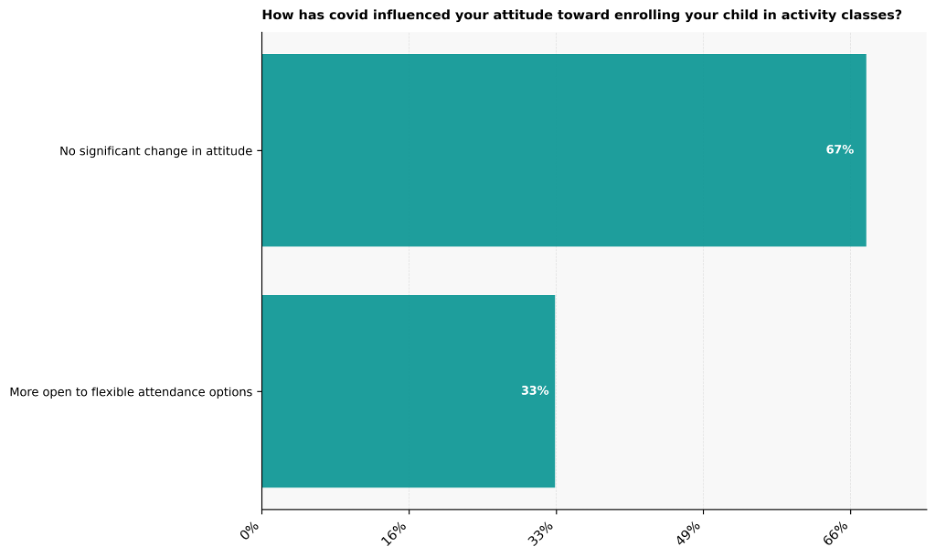
Given that major new research has shown how deeply the pandemic affected children and young people, it’s interesting how little Covid seems to have changed our attitudes toward enrolling children in activity classes. 67% of parents report no significant change in attitude, showing that many of us still see these sessions as a stable part of childhood.
At the same time, 33% of our audience says they are more open to flexible attendance options. The disruption to routines during the pandemic made many families more cautious about rigid commitments. Flexibility now makes it easier to manage busy weeks, illness, or changing schedules, while still keeping children involved on a regular basis.
What Type Of Activity Class Are You Most Interested In For Your Child?
Dance and movement is the top choice for 32% of parents interested in kids’ activity classes
Choices show a balance of creativity, movement, and personal fit:
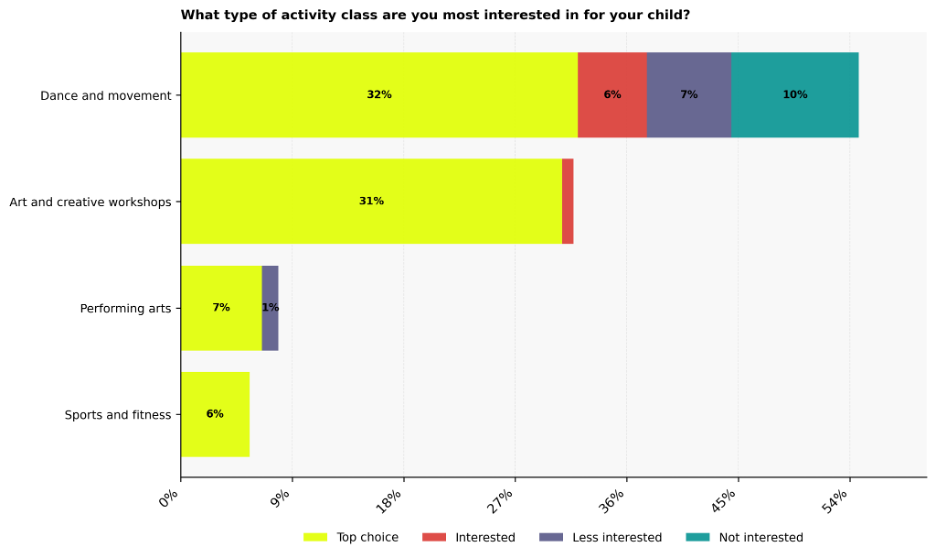
Dance and movement leads the types of activity class parents in our audience are most interested in for their children, with 32% naming it as their top choice, alongside 6% who are interested, 7% who are less interested, and 10% who are not interested. These classes offer a way for children to build coordination, confidence, and comfort in their own bodies, even though they do not suit every personality.
Art and creative workshops follow closely, with 31% placing them as a top choice and fewer than 1% listing them as simply interested. Children’s Parliament makes the point that creative arts enhance engagement and participation for children by offering ways to express their ideas, thoughts, and perspectives that feel comfortable and empowering.
Performing arts attract a smaller but focused group, with 7% selecting them as a top choice and 1% less interested, appealing to children who enjoy storytelling and performing. Sports and fitness sit at 6%, showing steady interest in teamwork, stamina, and healthy routines.
What Age Group Does Your Child Fall Into?
40% of parents in the UK considering kids’ activity classes say their children are in their early years
Parents of toddlers through to school-age children are investing in activities:
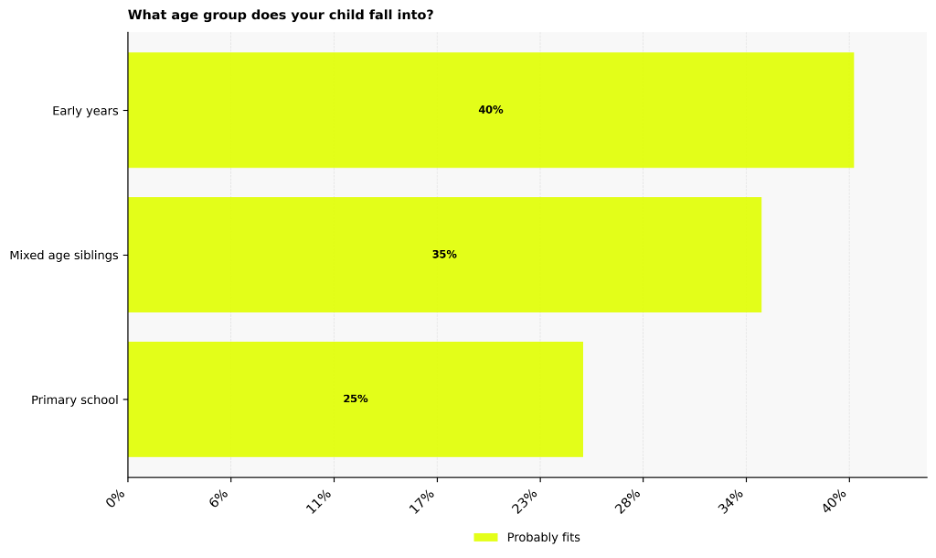
The age groups that children of parents in our audience fall into are led by early years, with 40% in this category. This suggests many families are looking for classes that focus on play, basic skills, and early confidence building at a formative stage.
Mixed-age siblings account for 35%, showing how often parents are trying to balance activities that suit more than one child at a time, prioritising convenience and shared experiences.
Primary school children make up the remaining 25%, pointing to growing interest in structured learning, teamwork, and personal development as children become more independent and socially engaged.
What Type Of Class Environment Do You Prefer For Your Child?
There’s a 50/50 split in parents who prefer an energetic and dynamic class environment and a supportive and nurturing one
Parents are choosing between two sides of the same coin:
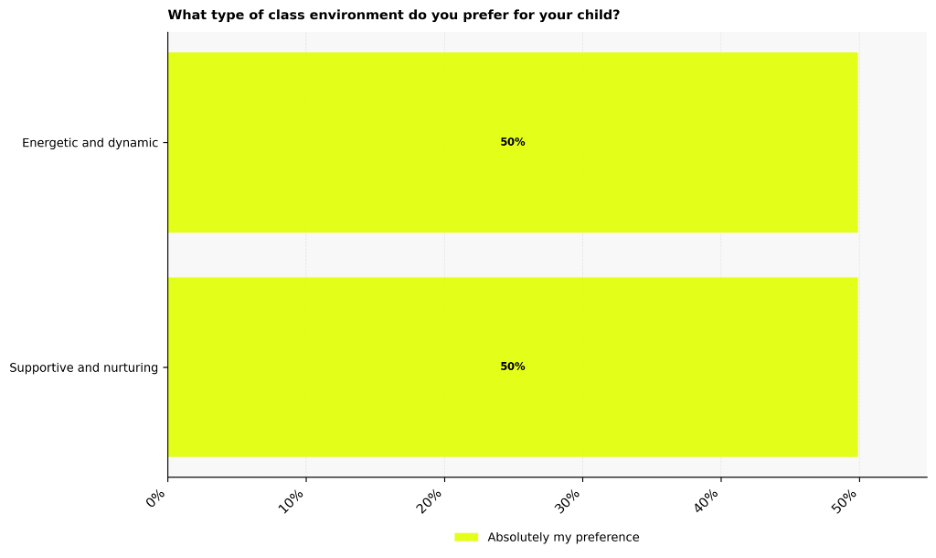
The type of class environment parents prefer for their child points to two equally important factors. Research into positive learning environments highlights active engagement and supportive relationships as central to participation and confidence. It shows how children take part more fully when they feel stimulated and comfortable, with peer interaction and a sense of belonging shaping how confidently they engage.
Among our audience, 50% prefer an energetic, dynamic setting, valuing pace, movement, and visible enthusiasm. The remaining 50% favour a supportive and nurturing environment, prioritising reassurance, connection, and emotional safety as the foundation for steady growth and participation.
How Important Is Performance Or Showcase Opportunity?
75% of UK parents say that performance or showcase opportunities are not a priority in kids’ activity classes
Most parents prefer progress over applause:
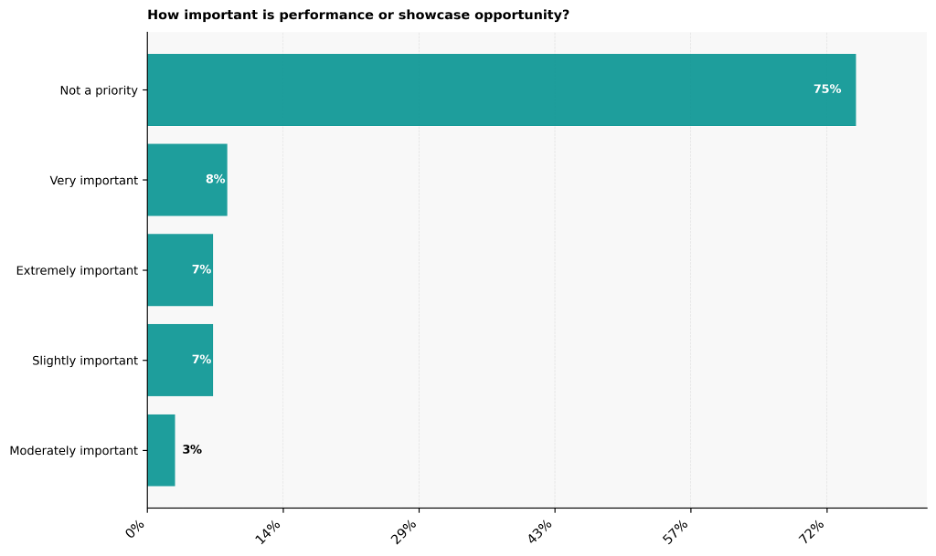
The importance of performance or showcase opportunities for parents is weighted toward everyday enjoyment rather than public display. For 75% of our audience, this is not a priority at all, suggesting that most of us are choosing classes for learning, confidence, and personal growth rather than for stage time or recognition.
A smaller group places strong value on visibility, with 8% saying it is very important and 7% rating it as extremely important, likely linked to children who enjoy performing, competition, or clear milestones. Another 7% see it as slightly important, showing openness to occasional showcases without wanting regular pressure.
The remaining 3% describe it as moderately important, balancing appreciation for shared moments with a preference for keeping activities relaxed and child-led.
How Do You Usually Discover New Kids’ Activity Classes?
85% of parents in the UK discover new kids’ activity classes on social media
Today’s word-of-mouth recommendations live online:
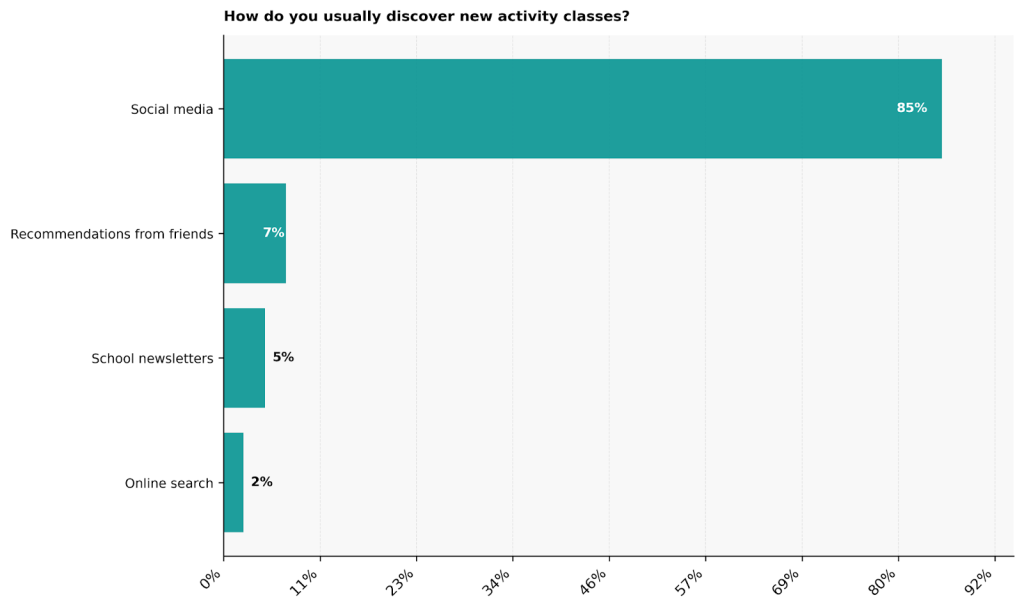
The way parents in our audience usually discover new kids’ activity classes is dominated by social media, with 85% naming it as their main source. In the UK, where there were 54.8 million social media user identities in January 2025, equating to 79% of the population, platforms like local groups and parent networks have become the quickest way to spot new options.
Recommendations from friends account for 7%, trusted because they come from parents who have already tested classes themselves. School newsletters, used by 5%, tend to suit families who prefer official, curated information linked to their child’s daily environment.
Only 2% rely on online search, proving that most parents see little concrete value in scrolling through generic listings or adverts.
How Do You Evaluate The Credibility Of A Kids’ Activity Class Provider?
100% of UK parents evaluate the credibility of a kids’ activity class provider by online reviews
One signal tells parents what they need to know:
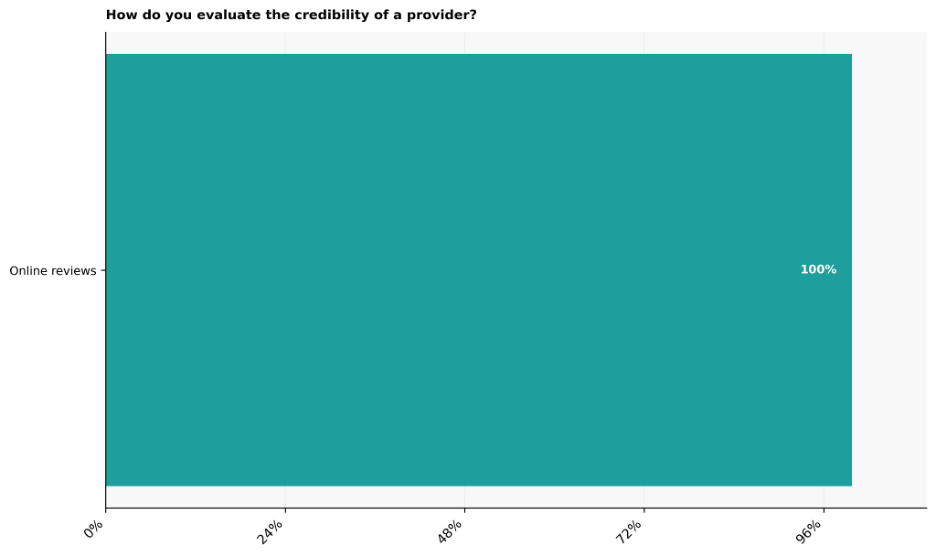
There’s no doubt about how parents in our audience evaluate the credibility of a kids’ activity class provider, with 100% relying on online reviews. This lines up with Trustpilot’s UK growth research, which found that 84% of consumers rank independent review platforms as the most important source of information when making decisions, ahead of social circles, professional endorsements, and company websites.
For many of us, reading what other families have experienced helps us understand what the sessions are really like, how instructors run them, and whether children actually enjoy attending before we sign up.
What Concerns You Most When Evaluating A Kids’ Class Provider?
For 48% of UK parents, the class environment is the top concern when evaluating a provider
Parents judge the whole experience, not just the timetable:
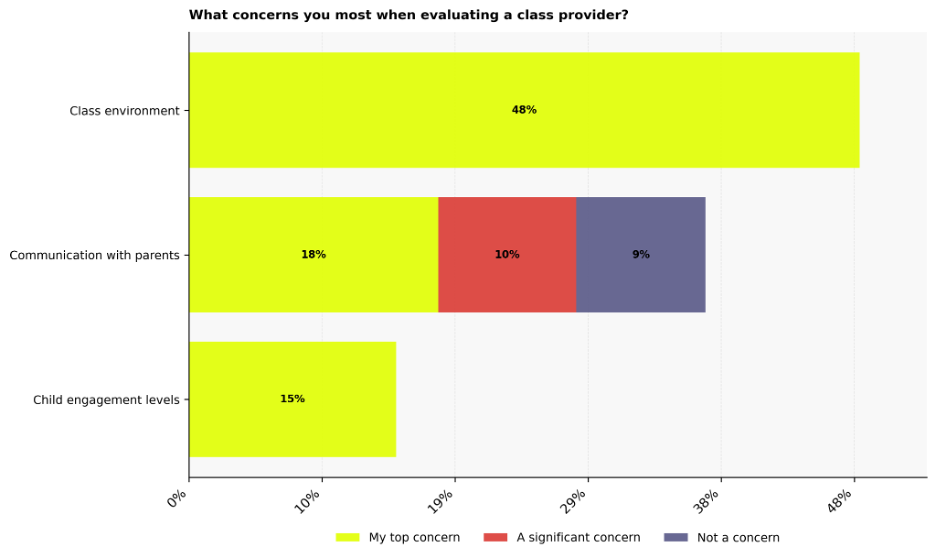
What concerns parents most when evaluating a kids’ activity class provider closely mirrors what we’ve already seen about preferred learning environments.
Class environment stands out as the top concern for 48%, showing how seriously families take the balance between energy and emotional support discussed earlier. Many of us are looking closely at whether sessions feel engaging, well-managed, and comfortable for different personalities.
Communication with parents follows, with 18% naming it as a top concern, 10% viewing it as a significant concern, and 9% saying it is not a concern, highlighting how much clear updates, responsiveness, and openness matter day to day.
Child engagement levels are the main focus for 15%, pointing to a desire to see children genuinely involved, interested, and enjoying their time rather than simply attending.
What Factor Influences Your Decision About a Kids’ Activity Class The Most?
100% of UK parents say that the quality of instructors has a strong influence on their decision about a kids’ activity class
Parents are unanimous about what matters most:
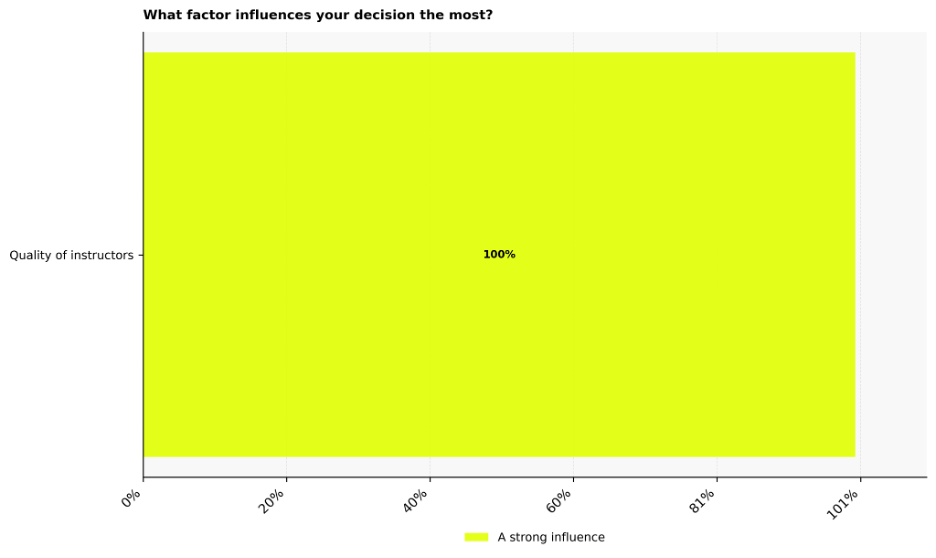
One factor influences parents’ decisions about their kids’ activity class the most. For 100% of our audience, it’s about the quality of instructors, showing how we value the people leading each session more than facilities, branding, or pricing.
Skilled instructors shape how confident children feel, how clearly activities are explained, and how supported different personalities become over time.
A great teacher can turn an average programme into something special, while weak instruction quickly undermines even the best-designed classes.
What Would Encourage You To Switch To A New Kids Activity Class Provider?
A more convenient location would only encourage 16% of parents to switch to a new kids’ activity class provider
Most parents prefer to stick with what works:
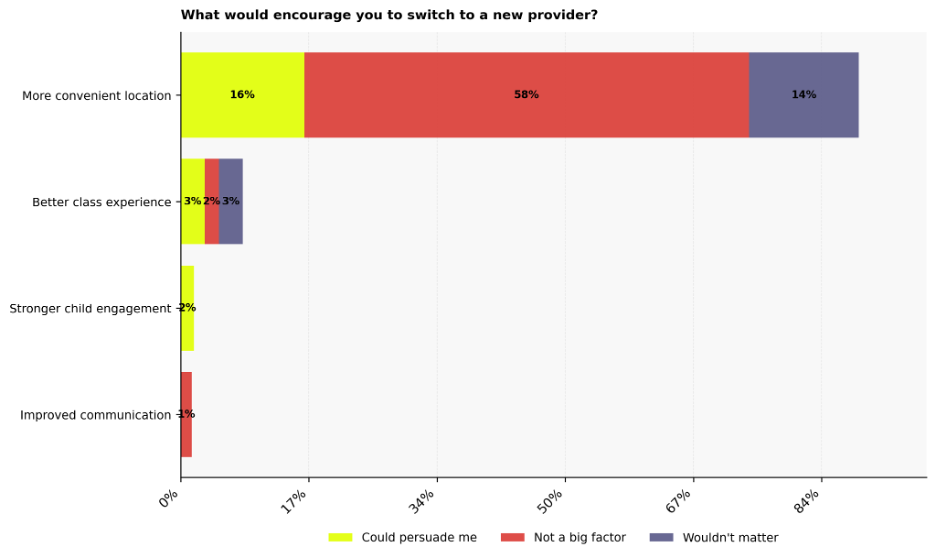
What would encourage parents in our audience to switch to a new kids’ activity class provider shows a strong preference for stability over change. A more convenient location could persuade 16% to move, but 58% say it is not a big factor, and 14% say it wouldn’t matter, highlighting how most families are willing to travel slightly further to stay with a trusted provider.
A better class experience could persuade 3%, with 2% saying it is not a big factor and 3% saying it wouldn’t matter, suggesting that small improvements rarely justify disruption. Stronger child engagement could persuade 2%, pointing to loyalty once children are settled, while improved communication is not a big factor for 1%, indicating most parents already feel well informed.
What Level Of Commitment Do You Prefer From A Class Provider?
35% of parents say that holiday workshops are their ideal choice from a class provider
Limited commitments feel more manageable:
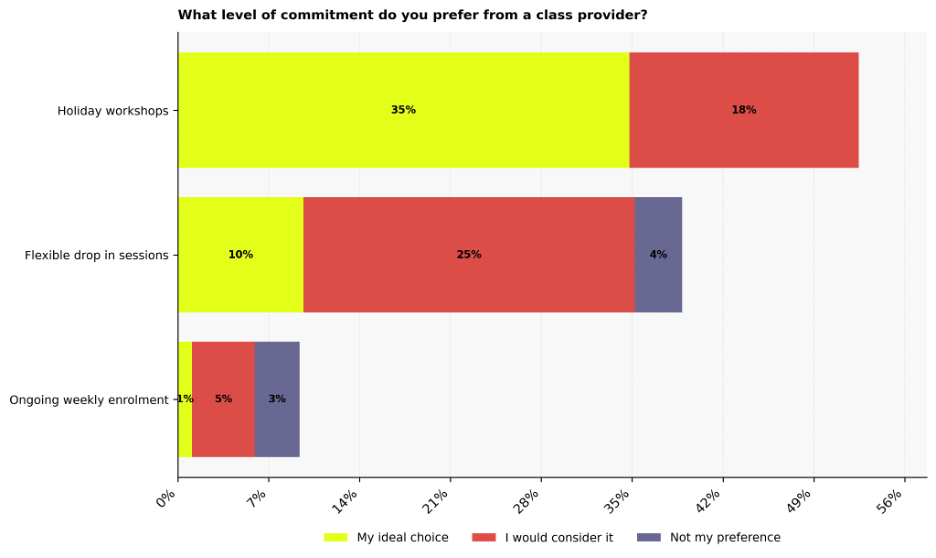
What level of commitment parents prefer from a class provider leans toward shorter, contained formats rather than long-term enrolment. Holiday workshops stand out, with 35% naming them as their ideal choice and a further 18% saying they would consider them. Holiday programmes combine learning, confidence-building, creativity, and social connection in a short, high-energy format, which helps explain their strong appeal.
Flexible drop-in sessions follow, with 10% seeing them as ideal and 25% saying they would consider them, while 4% say they are not their preference, revealing that flexibility matters but not at the expense of structure. Ongoing weekly enrolment attracts just 1% as an ideal choice, with 5% saying they would consider it and 3% saying it is not their preference, showing limited appetite for open-ended commitment.
How Do You Prefer To Book A Kids Activity Class?
55% of UK parents say they prefer to book a kids’ activity class on an online booking platform
Booking habits balance convenience and reassurance:
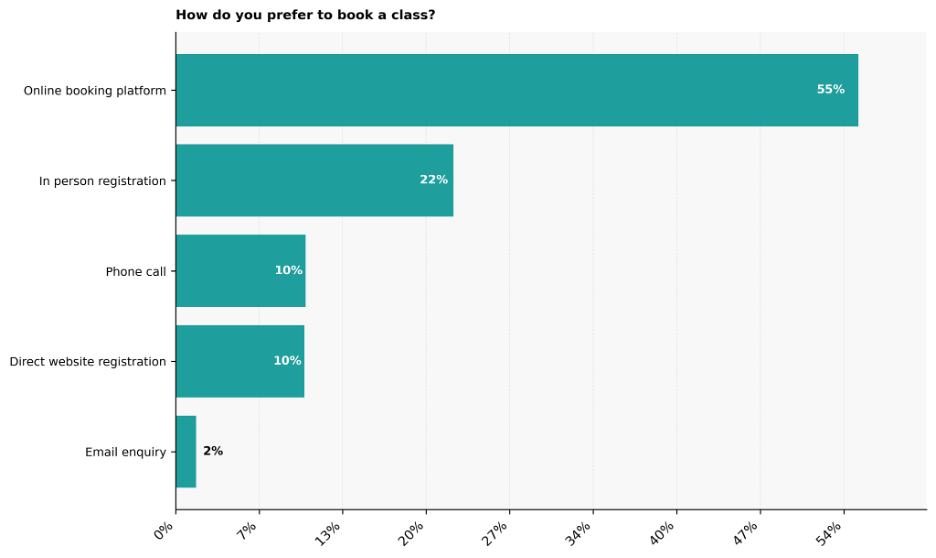
How parents prefer to book a kids’ activity class shows a shift toward speed and convenience. Online booking platforms lead, with 55% of our audience choosing this option, and this aligns with wider evidence that businesses see an average revenue increase of 27% after adopting online systems, showing that smoother booking benefits families and providers alike.
In-person registration remains important for 22%, often preferred by parents who value face-to-face reassurance and the chance to ask questions. Phone calls account for 10%, appealing to those who want immediate answers or personal guidance.
Another 10% favour direct website registration, typically used by parents who already know the provider and want a straightforward route. Email enquiries sit at 2%, showing how slower back-and-forth communication fits less easily into busy family routines.
What Type Of Communication Do You Value Most From A Class Provider?
100% of parents find feedback after every session an extremely valuable form of communication from a class provider
There’s no debate about what information parents value:
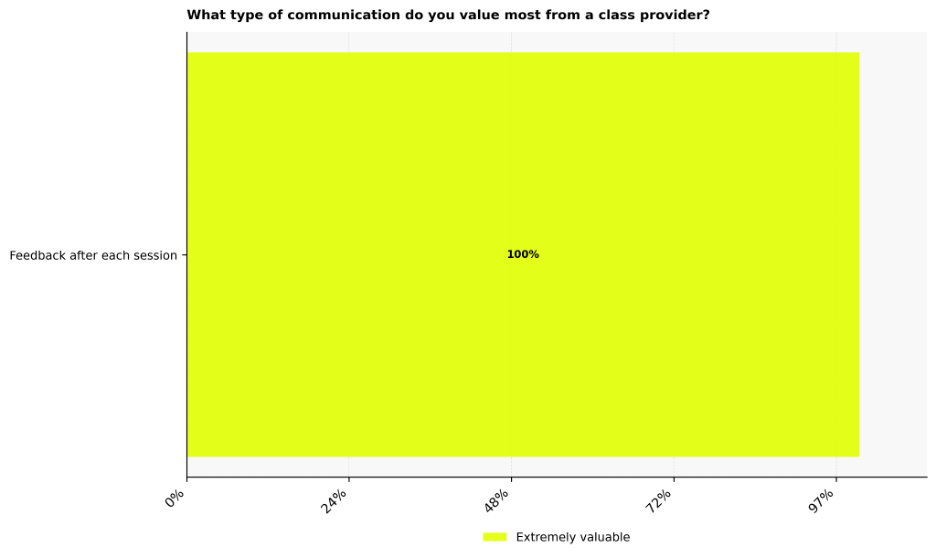
The type of communication parents in our audience value most from a class provider is clear, with 100% prioritising feedback after each session. This goes beyond simple updates and speaks to a wider desire to stay actively involved in children’s learning and development.
Evidence from the Education Endowment Foundation shows that strong parental engagement is linked to around four additional months’ progress over a year, underlining the value of keeping families informed and involved. For many of us, regular session feedback helps us understand what our children are working on, where they’re gaining confidence, and how we can support them at home.
What Industry Do You Work In?
56% of UK parents in our audience work in the healthcare sector
Parents in our audience work in two demanding sectors:
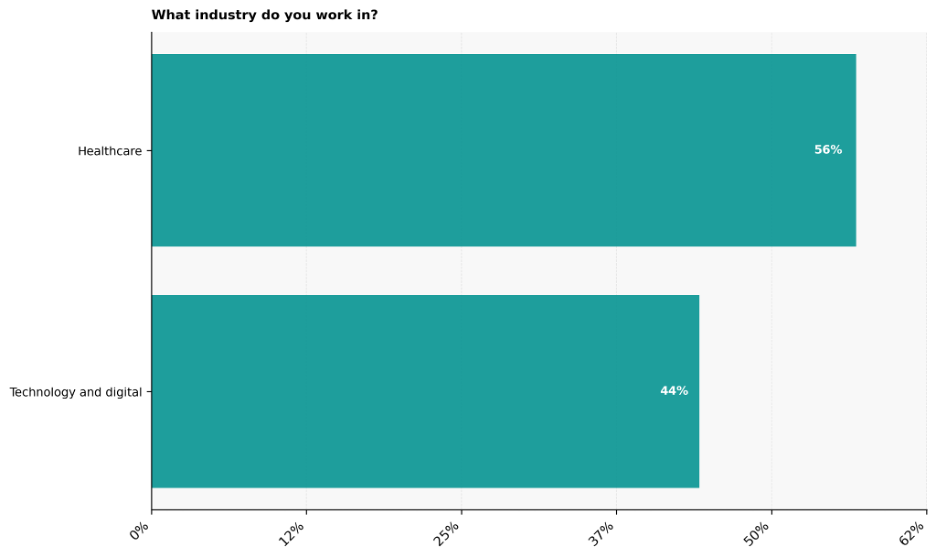
The industries that parents in our audience work in are concentrated in two sectors, pointing to families balancing shift work, long hours, and high-pressure roles alongside childcare and extracurricular commitments.
For the 56% of parents who work in healthcare, irregular schedules and weekend or evening work probably make reliability and clear planning essential. Meanwhile, the 44% of parents in technology and digital roles may have more flexible working patterns, but likely face blurred boundaries between work and home.
Which City Are You Based In?
39% of UK parents enrolling their kids in activity classes are based in Leeds
Activity demand centres on regional hubs:
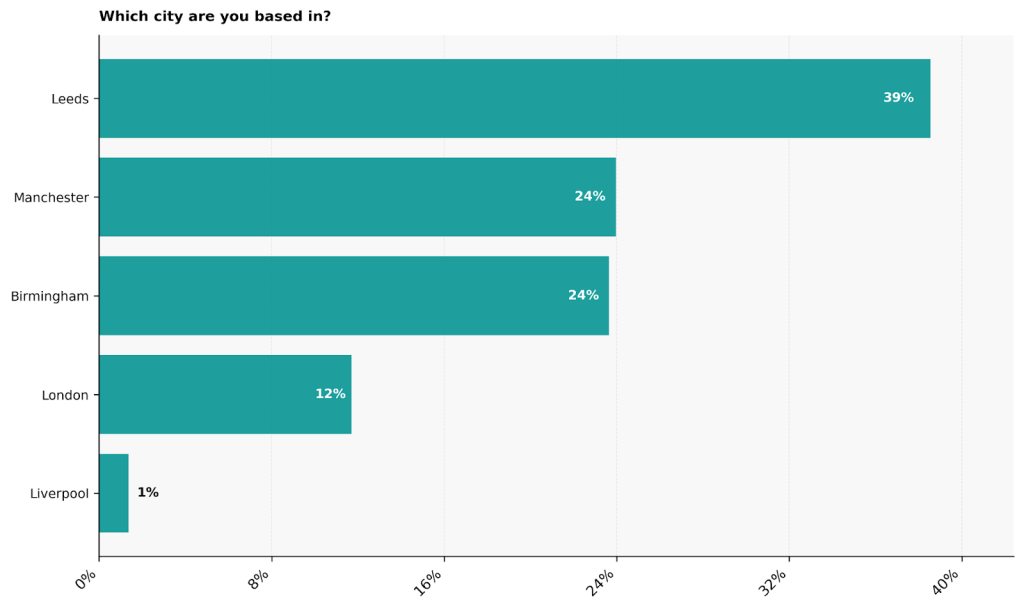
The cities parents in our audience are based in are led by Leeds at 39%, indicating strong local networks and a concentration of family-focused neighbourhoods where community-based classes are easy to access. Manchester and Birmingham both sit at 24%, linked to growing populations of young professionals and families who rely on organised activities to fit around busy working lives.
London accounts for just 12%, which aligns with a recent analysis by the Education Policy Institute showing falling pupil numbers as families move out of the capital or leave the state system. Liverpool stands at 1%, which may be linked to the city’s smaller digital and healthcare employment base compared with larger regional hubs, resulting in fewer parents in these sectors represented in this audience.
What Parents Really Look For in Kids’ Classes
Looking across these 47,632 opinions of parents across the UK, it’s clear that choosing a kids’ activity class is rarely about just one thing. We balance enjoyment, teaching quality, flexibility, communication, and practical fit when deciding what works for our children and our routines.
In the end, the classes we return to are the ones that go beyond filling time after school, helping our children build confidence, explore their interests, and feel genuinely supported as they grow.
About The Data
Sourced using Push from an independent sample of 47,632 opinions of parents in the UK across X, Quora, Reddit, Bluesky, TikTok, and Threads. Responses are collected within a 95% confidence interval and 5% margin of error. Results are derived from what people describe online, from opinions expressed, not from actual questions answered by people in the sample.